
Overview
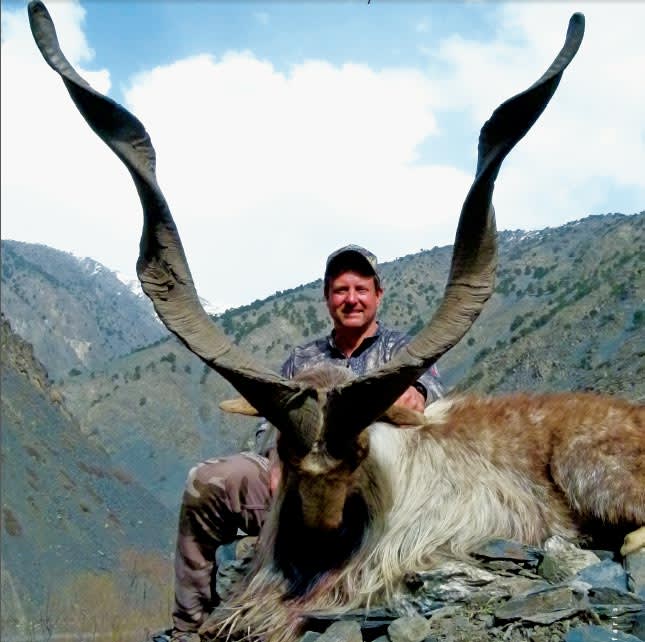
A large markhor with massive horns that usually are the longest of the species. The coat and ruff are similar to those of the Astor race. Typically, Kashmir markhor horns have slight to moderate flare with 2-3 spiral twists. Most horns within its distribution range are of this type; however, straighter horns of the Kabul type have occurred in the Chitral District. According to Stockley, the record head measured 65-3/4 inches (167 cm) around the spiral along the keel that begins at the back of the base (which is the SCI method). It came from Mozi Nullah in the Kaj-i-Nag range in India in 1924. The Rowland Ward record is 65 inches (165.1 cm) from the Kafr Nullah in Kashmir in 1927. Females have slim horns up to 14 inches (36 cm) long that usually have 1-1/4 twists and tips that diverge outward.
Taxonomy
- Kingdom
- Animalia
- Phylum
- Chordata
- Class
- Mammal
- Order
- Artiodactyla
- Family
- Bovidae
- Genus
- Capra
- Species
- Capra falconeri
Habitat
This markhor is not a high altitude animal because it generally avoids deep snow and the cold. They avoid the higher elevations inhabited by Himalayan ibex but remain close to precipitous mountain sides. Distribution- Laghman Province and the Bashgul River area. Pakistan: Chitral District, along the Kunar River from Shogore to Arandu on the west bank and to Drosh on the east bank, and up its tributary the Mastuj River as far as Barenis; Dir District, along the upper Panjkora River; and Swat District on the cliffs east of Mankial. India: The Shamsberi, Kaj-i-Nag, and Pir Panjal ranges.
Diet
Grasses, lichens, mosses, and willow sprouts.
Behavior
The mating season occurs in winter, during which the males fight each other. The gestation period lasts 135 to 170 days, after which usually one or two offspring are born. The Markhor live in flocks, numbering usually close to ten animals, composed of adult females and their offspring. Adult males are largely solitary. Their alarm call closely resembles the bleating of domestic goats.
Hunting
As with other species in northern Pakistan, markhor hunts are held in several community controlled hunting areas (CHAs) where 80% of the license fee is turned over to the communities to ensure sustainability of conservation initiatives. Difficulty varies when hunting markhor, depending on terrain and weather. When these animals are on cliffsides or out of shooting range, hunters must be patient, as the markhor will frequent a water resource every other day. Most hunting is done on foot but some driving may be needed.
Conservation Status
Listed as Near Threatened by the IUCN.