
Overview
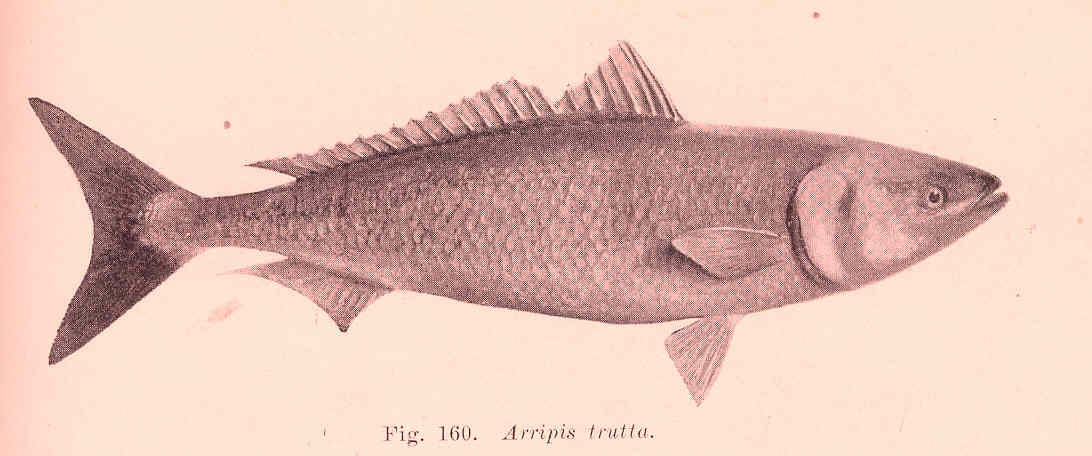
The body varies from blue green or greenish to silvery with scattered dark gray, brown, or golden spots. Often mistaken for southern yellowtail, it can be quickly and easily distinguished by its lack of a yellow stripe along the body and its high first dorsal fin. The name “Australian salmon” is something of a misnomer, as it is in no way related to the true salmon or their relatives (Salmonidae).
Taxonomy
- Kingdom
- Animalia
- Phylum
- Chordata
- Class
- Actinopterygii
- Order
- Aulopiformes
- Family
- Arripidae
- Genus
- Arripis
- Species
- trutta
Habitat
They inhabit continental shelf waters including estuaries, bays and inlets. They school in shallow, open coastal waters or form large surface aggregations in deeper water.
Diet
They feed actively on anchovies and other small fish and can be caught on these or on fast moving lures.
Behavior
Kahawai are highly social fish that form large schools, often migrating along coastlines in search of food. They are active predators during the day, aggressively chasing schools of smaller fish near the surface. This schooling behavior helps them evade predators and coordinate hunting efforts.
Fishing
They are highly prized by anglers and commercial fishermen. Large concentrations of feeding birds often indicate the presence of kahawai, which go into surface feeding frenzies similar to those of bluefish (tailor). They feed actively on anchovies and other small fish and can be caught on these or on fast moving lures. On light tackle, the kahawai is a very sporting catch and will leap repeatedly. It is also ideally suited to fly fishing
Conservation Status
Listed as Not Evaluated by IUCN.