
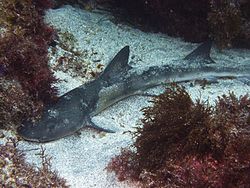
Taxonomy
- Kingdom
- Animalia
- Phylum
- Chordata
- Class
- Chondrichthyes
- Order
- Squaliformes
- Family
- Triakidae
- Genus
- Hemitriakis
- Species
- japonica
Habitat
Japanese topesharks primarily inhabit continental shelves in the Northwest Pacific Ocean, at depths ranging from 10 to 300 meters over sandy or muddy bottoms. They prefer coastal waters near Japan, China, Korea, and Taiwan, occasionally entering estuaries or shallow bays. These areas provide ample cover and food sources in temperate to subtropical marine environments.
Diet
Japanese topesharks mainly consume bottom-dwelling prey such as crabs, shrimp, small fish, and mollusks. They are nocturnal hunters that use their barbels to detect and capture food on the seafloor, with feeding activity peaking at night. Their feeding behavior involves ambushing prey in murky waters for efficient energy use.
Behavior
Japanese topesharks are solitary and primarily nocturnal, resting on the ocean floor during the day and actively hunting at night. They exhibit territorial behavior around feeding areas but do not form large groups or migrate long distances. These sharks are generally cautious and may hide in crevices when threatened.
Conservation Status
Listed as Least Concern by IUCN.