
Overview
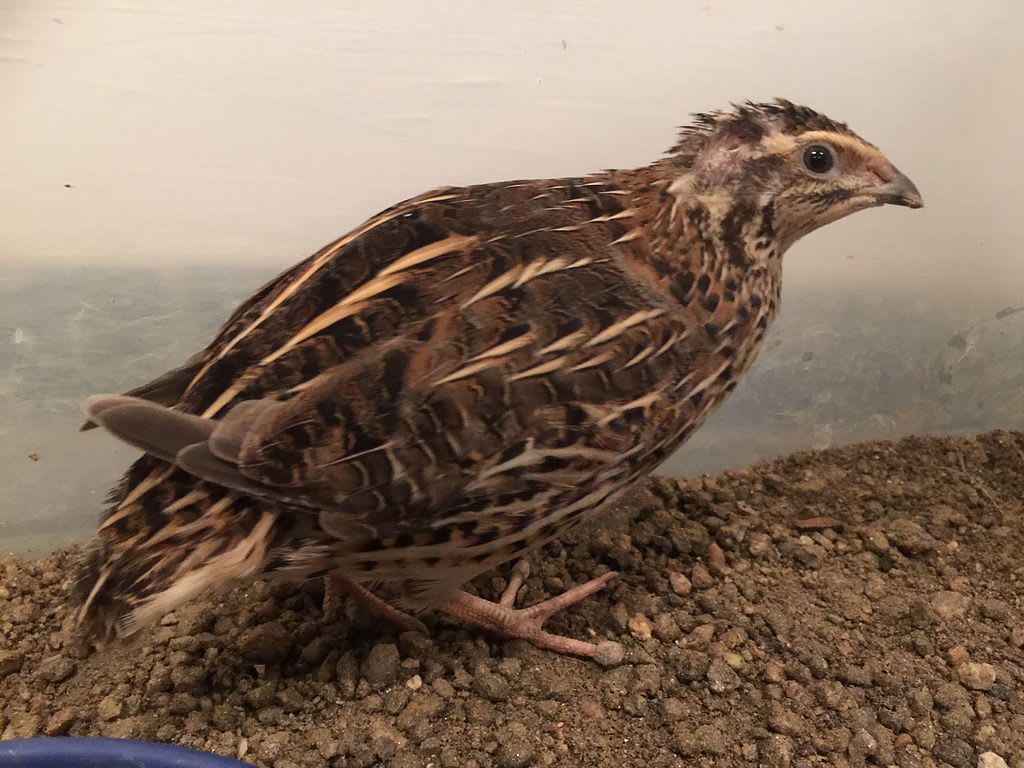
The morphology of the Japanese quail differs depending on its stage in life. As chicks, both male and female individuals exhibit the same kind of plumage and coloring. Their heads are tawny in color, with small black patches littering the area above the beak. The wings and the back of the chick are a pale brown, the back also having four brown stripes running along its length. A pale yellow-brown stripe surrounded by smaller black stripes runs down the top of the head. The plumage of the Japanese quail is sexually dimorphic, allowing for differing sexes to be distinguished from one another. Both male and female adults exhibit predominantly brown plumage. However, markings on the throat and breast, as well as the particular shade of brown of the plumage, can vary quite a bit. The breast feathers of females are littered with dark spots among generally pale feathers. Contrastingly, male breast feathers show off a uniform dark reddish-brown color that is devoid of any dark spots. This reddish-brown coloration also appears in the male cheek, while female cheek feathers are more cream colored. Some males also exhibit the formation of a white collar, whereas this does not occur in any female members of the species. It is important to note that while this coloration is very typical of wild populations of Coturnix japonica, domestication and selective breeding of this species has resulted in numerous different strains exhibiting a variety of plumage colors and patterns.
Taxonomy
- Kingdom
- Animalia
- Phylum
- Chordata
- Class
- Bird
- Family
- Phasianidae
- Genus
- Coturnix
- Species
- japonica
Habitat
The Japanese quail is primarily a ground-living species that tends to stay within areas of dense vegetation in order to take cover and evade predation. Thus, its natural habitats include grassy fields, bushes along the banks of rivers, and agricultural fields that have been planted with crops such as oats, rice, and barley. It has also been reported to prefer open habitats such as steppes, meadows, and mountain slopes near a water source.
Diet
Grain seeds, grass seeds, insects and insect larvae, other invertebrates.
Behavior
Body length 7.1-8.62 inches (18-22 cm).The Japanese quail exhibits a quite distinct and specific mating ritual. First, the male grabs the neck of the female and mounts her. After mounting the female, the male extends his cloaca by curving his back in an attempt to initiate cloacal contact between him and the female. If cloacal contact is achieved, insemination of the female will be exhibited by distinguishable foam present in the female's cloaca. After successfully mating with a female, the male characteristically performs a distinctive strut. Females will either facilitate the mating attempts of the male by remaining still and squatting in order to ease the access of the male to her cloaca or impede the attempts of the male by standing tall and running away from him. Females can also induce the initial sexual interactions by walking in front of a male and crouching. Males acting aggressively toward a female during the mating ritual have been shown to reduce successful matings. Egg weight, color, shape, and size can vary greatly among different females of a Japanese quail population; however, these characteristics are quite specific and consistent for any given female. Eggs are generally mottled with a background color ranging from white to blue to pale brown. Depending on the strain of the Japanese quail, eggs can weigh anywhere from 8 to 13 grams, though the accepted average weight is 10 grams. Age seems to play a role in the size of eggs produced as older females tend to lay larger eggs.
Hunting
More information needed.
Conservation Status
Listed as Near Threatened by IUCN.