
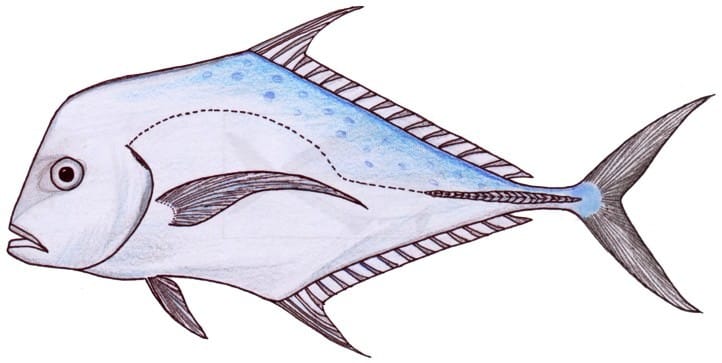
Taxonomy
- Kingdom
- Animalia
- Phylum
- Chordata
- Class
- Actinopterygii
- Order
- Cichliformes
- Family
- Carangidae
- Genus
- Alectis
- Species
- indicus
Habitat
This fish inhabits coastal marine waters, often over sandy or muddy substrates and around coral reefs. It prefers warm tropical and subtropical regions in the Indian and Pacific Oceans, typically from the surface to depths of about 100 meters. They are commonly found in areas with strong currents and abundant prey.
Diet
The Indian threadfin primarily feeds on smaller fish, crustaceans like shrimp and crabs, and cephalopods such as squid. It hunts actively in schools or alone, using its speed to chase down prey. Feeding activity peaks during the day in open waters.
Behavior
Indian threadfin are schooling fish that form large groups for protection and feeding. They are diurnal, active during the day for hunting and less active at night. They exhibit fast swimming and agile maneuvers but are not particularly territorial.
Fishing
The Indian threadfin is a popular sport and food fish in the Indian and Pacific Oceans, offering exciting fights for anglers in coastal marine waters with sandy or muddy substrates, around coral reefs, and in areas with strong currents up to 100 meters deep—target these spots during daylight hours when the fish are most active. Employ trolling, casting, or jigging techniques with medium-heavy rods (7-9 feet), reels with 20-30 lb test line and strong drags, and hooks sized 2/0 to 5/0; use live baits like shrimp, small fish, or crabs, or artificial lures such as metal jigs and spoons that imitate their prey like smaller fish and cephalopods for the best results. The prime season is the warmer months when spawning occurs, enhancing activity and catch rates. The IGFA all-tackle world record is 35 pounds 4 ounces, highlighting the species' impressive size potential. As a Least Concern species per IUCN, conservation is bolstered by angler-funded programs through license fees that support habitat protection and stocking initiatives, with effective management tools like slot limits and catch-and-release practices in some regions ensuring sustainable populations and the continued health of these tropical waterways.
Conservation Status
Listed as Least Concern by IUCN.