
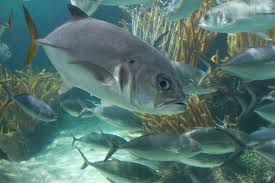
Overview
The body is compressed, though the profile of the head is not as vertical or as blunt as in large crevalle jacks, Caranx hippos. The eyes are characteristically of the horse-eye jack are large and have thick, adipose eyelids. There is a small black spot on the operculum, but there is no spot on the pectoral fin as in the crevalle jack. The straight portion of the lateral line has 32 39 scutes.
Taxonomy
- Kingdom
- Animalia
- Phylum
- Chordata
- Class
- Actinopterygii
- Order
- Cichliformes
- Family
- Carangidae
- Genus
- Caranx
- Species
- latus
Habitat
It occurs in small schools around off shore islands and reefs, deep bluewater holes, channels adjacent to flats, and in shore along sandy beaches. It is also known in brackish water and, occasionally, in freshwater coastal rivers and streams.
Diet
It feeds primarily on fish, but also on shrimp, crabs, and other invertebrates.
Behavior
Horse-eye jacks are highly social, often forming schools of up to several dozen individuals that patrol reefs and open waters. They are diurnal predators, actively hunting during the day and exhibiting fast, agile swimming to chase prey. These fish can be territorial around feeding areas and are known for their explosive leaps when hooked by anglers.
Fishing
It is a good light tackle game fish that can be taken with live baits such as mullet, pinfish, or other small fishes, as well as with plugs, jigs, spoons and flies. Lures should be retrieved at a fast pace without slowing or stopping. Like other jacks, it is edible but not highly esteemed as a food fish. The flesh is dark and relatively tasteless, though this can be improved by cutting off the tail and bleeding the fish immediately after capture. It is one of many tropical species which have been implicated in ciguatera poisonings (see barracuda, great).
Conservation Status
Listed as Least Concern by IUCN.