
Overview
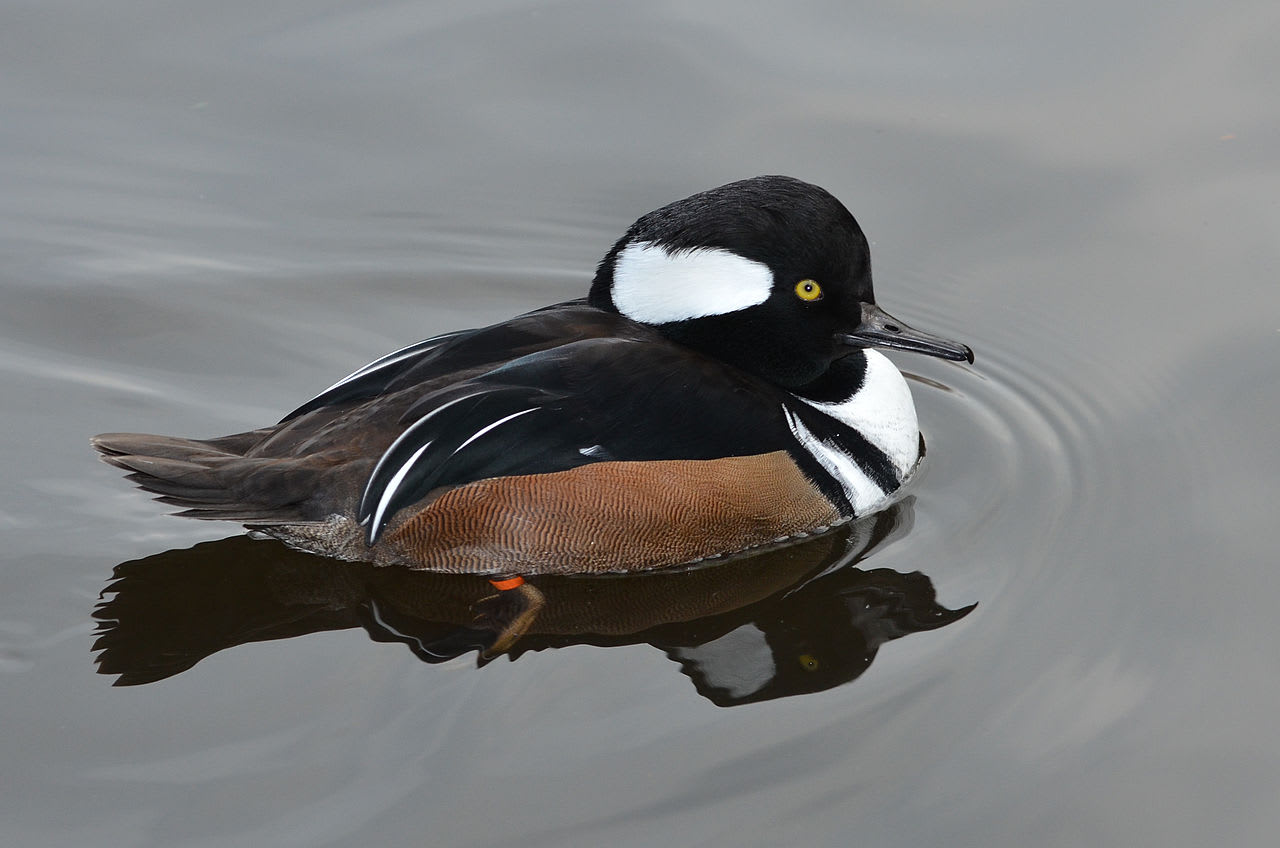
The Hooded Merganser is the smallest of the three Merganser birds in North America. These birds have an average length of around 17 inches and an average weight of around 1.5 lbs.. The drake is black on the head, neck, and back followed by a white breast and belly. The head has a large white crest. It has a long serrated black bill with irises of the eye colored bright yellow. The female Hooded Merganser have a brownish head and neck with a reddish crest. She has a grey colored neck, chest and sides, with black brown back and tail. The upper bill of the Hooded Merganser hen is black edged with orange followed by a lower orange bill. They prefer wetland forest areas where they will nest in tree cavities or in nest boxes. They dive in fresh water to feed on small fish, crayfish, and other strains of aquatic species.
Taxonomy
- Kingdom
- Animalia
- Phylum
- Chordata
- Class
- Bird
- Family
- Anatidae
- Genus
- Mergus
- Species
- cucullatus
Habitat
Breeding for theses birds take place in Alaska, British Columbia, Oregon, Idaho, Montana, and some areas of Louisiana and Georgia. They also breed in several other locations throughout the United States. These birds are known to be restricted to the continent of North America. They will winter along the Pacific, Atlantic, and Gulf Coast. The majority of these birds migration takes place along the Mississippi Flyway.
Diet
The hooded merganser is a diving predator that largely hunts by sight while under water. Most studies report that its diet varies according to circumstances, usually being dominated by fishes (44-81%). In addition it feeds on aquatic insects (13-20% of its diet) and other aquatic invertebrates such as crabs and crayfish (22-50%).
Behavior
Males and females of the hooded merganser form monogamous pairs and they remain together until the female has selected a nesting cavity and completed laying her clutch. After that, the male leaves the female to incubate and care for the brood. Females will actively seek out cavities in dead trees or artificial nest boxes such as those provided for nesting wood ducks. They prefer cavities 4–15 feet off the ground. Breeding occurs anytime between the end of February and the end of June, depending on the region.
Hunting
Typically hunted with a 12 ga shotgun. Shot size #2-4 is sufficient. Effectively hunted with decoys and calling. Dogs are used for bird retrieval. Steel shot is required for waterfowl in the United States.
Conservation Status
Listed as Least Concern by IUCN.