
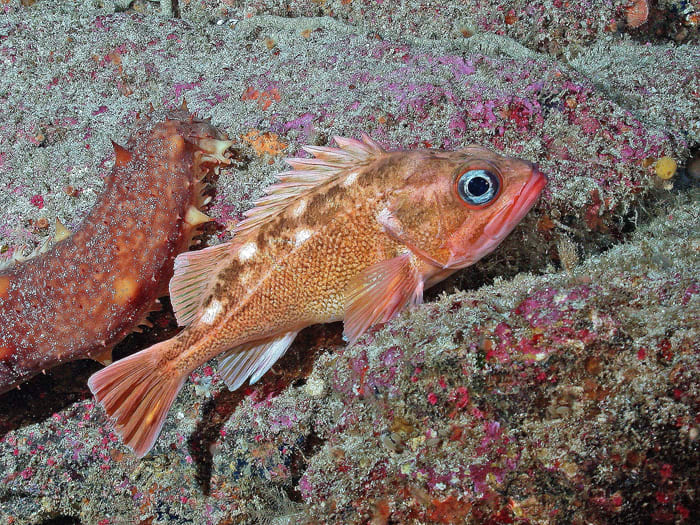
Taxonomy
- Kingdom
- Animalia
- Phylum
- Chordata
- Class
- Actinopterygii
- Order
- Salmoniformes
- Family
- Sebastidae
- Genus
- Sebastes
- Species
- umbrosus
Habitat
Honeycomb rockfish inhabit rocky reefs, kelp forests, and areas with abundant cover in the eastern Pacific Ocean, primarily from central California to Baja California. They prefer depths of 30 to 300 meters where there are strong currents and plenty of hiding spots. These environments provide protection from predators and access to food sources.
Diet
Honeycomb rockfish primarily feed on small fish, squid, and crustaceans such as shrimp and crabs. They are ambush predators, hiding in rocky crevices and striking at prey that passes by, often feeding more actively at dusk or night. Their diet varies seasonally based on prey availability in their habitat.
Behavior
Honeycomb rockfish are typically solitary or found in small groups, often hiding in rock crevices during the day and becoming more active at night. They exhibit territorial behavior, defending their hiding spots from intruders, and are generally slow-moving unless pursuing prey. These fish rely on camouflage for protection rather than speed.
Fishing
As a proven conservation tool, recreational fishing for honeycomb rockfish supports vital funding for marine habitat restoration through license fees and excise taxes, helping maintain healthy populations in the Pacific. Target these fish using bottom fishing techniques like jigging or bait fishing around rocky reefs and kelp forests in depths of 30 to 300 meters, where they hide in crevices and ambush prey; cast weighted lines or use drop-shot rigs for precision. Opt for light to medium tackle, such as a 7- to 9-foot rod with 15- to 30-pound test line, paired with size 1/0 to 2/0 hooks baited with shrimp, squid, or small fish imitations, or try metal jigs and soft plastics that mimic their diet of crustaceans and small fish for effective strikes. The best seasons are summer and fall when they are more active, with prime times at dusk or night for better bites due to their nocturnal feeding habits; focus on areas from central California to Baja California, such as Point Pinos or San Martin Island, where strong currents provide ample cover. Record sizes include specimens up to 30 cm in length and 1 lb 4 oz, with no specific IGFA all-tackle record noted, but always check local regulations for slot limits and size restrictions that ensure sustainable populations. Conservation efforts, including catch-and-release practices and managed fishing seasons, are effective tools funded by anglers to combat population declines from overfishing, promoting long-term protection of these habitats.
Conservation Status
Listed as Not Evaluated by IUCN.