
Overview
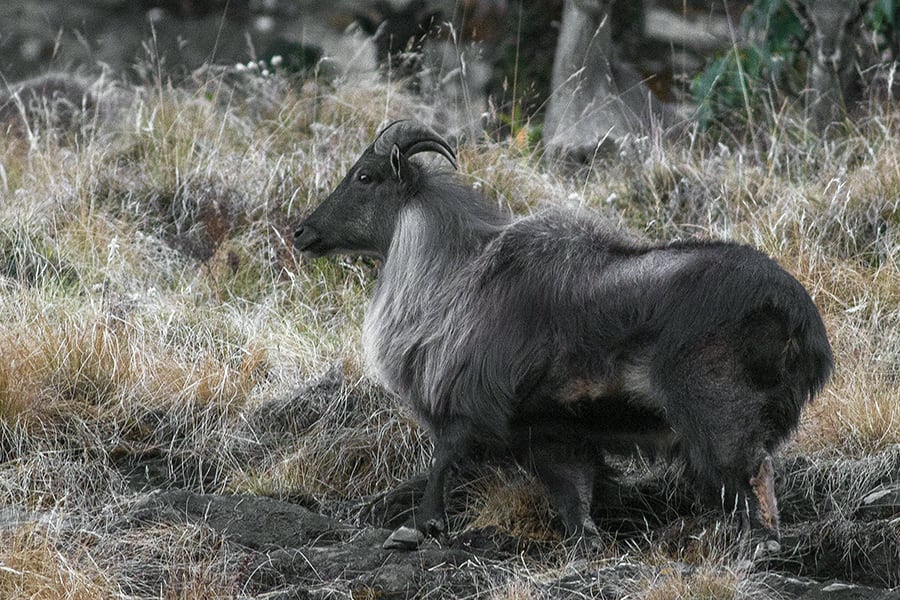
A powerfully built animal with a full coat of hair and a shaggy mane around the neck and shoulders, extending to the knees. The overall color varies, but in most cases is dark reddish-brown with a yellowish mane and a dark, sometimes indistinct, dorsal stripe. The face is dark brown. The horns in both sexes are short and stout, laterally compressed, keeled in front and curved backward to a tapered point. The female has smaller horns, lacks a mane, and has two pairs of teats (like the Arabian tahr, but unlike the Nilgiri tahr, which has one pair). According to Stockley (1928), horns of 14 inches (35.6 cm) are exceptional and 11-1/2 inches (29.2 cm) considered a trophy. The longest record measured 16-3/4 inches (42.5 cm) (Rowland Ward, 1927).
Taxonomy
- Kingdom
- Animalia
- Phylum
- Chordata
- Class
- Mammal
- Order
- Artiodactyla
- Family
- Bovidae
- Genus
- Hemitragus
Habitat
A combination of big cliffs, rocks and forest. Prefers to live on steep timbered slopes. Females prefer open summit areas, while males tend to inhabit the wooded cliffs below. Distribution- A narrow strip along the southern flanks of the Himalayas from about Banihal Pass in the Pir Panjal Range of northern India eastward to Bhutan. Penetrates the main Himalayan Range only in some of the large gorges. Outside Asia, has been introduced in the wild on the South Island of New Zealand and in parts of South Africa, and on private properties in the United States, Argentina and Austria. Other introductions in Scotland and Canada have failed.
Diet
This animal both grazes and browses based on seasonal availability.
Behavior
Gregarious, in large herds, with adult males forming separate herds during the summer. The tahr has remarkable climbing ability on the steepest cliffs. Does not like snow, keeping below it to as low as 5,000 feet (2,200 m), then ascending as the snow recedes. Active morning and evening, resting midday. Eyesight is very good, hearing and sense of smell not known.
Hunting
These animals are wary and difficult to approach. Because these animals inhabit some of the least accessible places in the world, shot selection is imperative, as one would not want to take an animal that they cannot recover.
Conservation Status
The South African introduction took place in 1935 when a pair were sent to Groote Schuur Farm, near Cape Town. Two years later some animals escaped to the precipitous slopes of Table Mountain, where by 1974 they had multiplied to around 600. A culling program was started, and by 1981 about 600 had been killed; however, the population remains strong. Introductions have also been made in the former homeland of Ciskei, now part of Eastern Cape Province. A breeding population has been established in the far southern area of Buenos Aires Province of Argentina. This population has a small sustainable harvest capability. Other breeding populations will likely develop as a non-indigenous hunting species. According to Lever, the first Himalayan tahrs were imported to New Zealand in 1904 when three pairs, originally from India, were shipped from Woburn Abbey in England to the New Zealand Tourist Board and released near Mt. Cook. Eight more were imported and released on Mt. Wakefield in 1909. In 1931 and 1937, progeny of these animals were set free near Mt. Cook and in the Sealey Range. The introductions were highly successful, as is evinced by records showing that more than 30,000 tahrs were killed by government cullers between 1937-1984.