
Overview
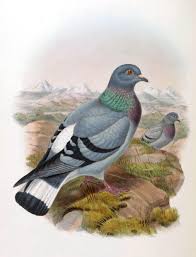
The hill pigeon is a stout bodied pigeon, very similar in size and general appearance to the rock pigeon, but mainly differentiated by its tail pattern which consist of a broad white tail-band across the black tail. Other differences include a paler mantle and upper wings and a white patch on the back. In flight, the tail pattern is similar to the snow pigeon, but lacks the contrast between the head and neck in that species.
Taxonomy
- Kingdom
- Animalia
- Phylum
- Chordata
- Class
- Bird
- Family
- Columbidae
- Genus
- Columba
- Species
- rupestris
Habitat
Open rugged country from 1,500 to 6,100 meters.
Diet
Their feeding habits are similar to rock pigeons, being mainly granivorous, supplementing their diet with green shoot and leaves and occasionally small mollusks such as snails. On some occasions, they become very opportunistic, feeding on leftover food, partially digested food from kiang dung and even undigested food from stomach of kiang carcass which are ripped open by other predators.
Behavior
Closely related to the rock pigeon but more commonly found at higher altitudes. A gregarious species throughout the year, they feed in flocks in the terraced cultivated fields. They often mix with flocks of rock pigeons. They are very tame and are often found near human settlements, camps and pilgrimage routes. In Tajikistan it has been recorded as starting to nest as early as February with many young just fledging as late as September in northeastern Tibet. The males have a bowing display similar to that of the rock pigeon and nothing distinctive seems to have been recorded elsewhere about the display of this pigeon which suggests that display and courtship is similar. They nest in dense colonies on cliffs, gorges and rocky outcrops. In Tibet, the nests are often placed houses, both inhabited and empty or in holes in the wall. Nest consists of a platform of twigs or plant stem in which generally two eggs are laid. They may raise two brood in a year.
Hunting
More information is needed.
Conservation Status
Listed as Least Concern by IUCN.