
Overview
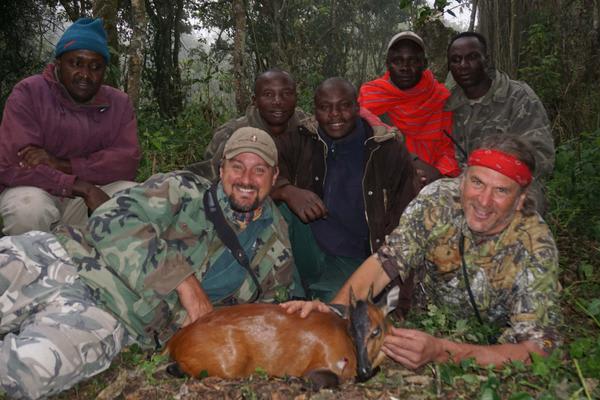
Slightly larger than the Natal red duiker, with much brighter coloration and slightly longer horns. The general color is a rich red becoming lighter below. There is a black stripe from nose to forehead, including the head tuft, and continuing down the back of the neck, where it gives way to a dark speckling. In parts of its distribution range, the dark color extends to the shoulders. The legs vary in color from brownish to brownish black. Inguinal (groin) glands are present. The horns (in both sexes) are similar to those of the Natal red duiker, being short, thick, conical, strongly ringed at the base, and inclined backward in the plane of the face. Females are similar to males, but are a little larger in body and have smaller horns.
Taxonomy
- Kingdom
- Animalia
- Phylum
- Chordata
- Class
- Mammal
- Order
- Artiodactyla
- Family
- Bovidae
- Genus
- Cephalophus
Habitat
Forest and thick bush, including mountain forest to 11,000 feet (3,400 m). Distribution- The Harvey red duiker is the most widespread red duiker in East Africa, occurring in central and northeastern Tanzania, locally in central and southeastern Kenya, and in southwestern Somalia, especially along the lower Jubba River.
Diet
These animals browse on plants and fallen fruit.
Behavior
Solitary and nocturnal, concealing itself in a protected place during the day.
Hunting
Hunted either by shotgun, or a high caliber solid bullet due to it passing through without expansion, causing little damage to the meat and hyde. Often taken as a chance occurance while hunting other species.
Conservation Status
Listed as Least Concern by IUCN.