
Overview
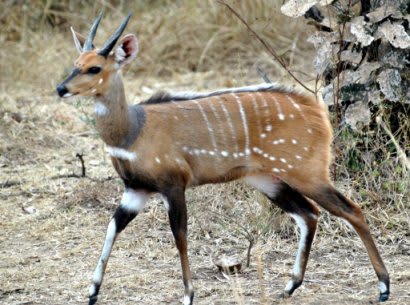
Body and horns are smaller in the western parts of its distribution range, increasing in size toward the east. The ground color is a chestnut red, with the harness pattern very pronounced. Females are a lighter shade, with more conspicuous stripes and spots. They are smaller then the Imbabala and any of it's subspecies which are also commonly known by their names bushbuck and are similair in appearance to this species.
Taxonomy
- Kingdom
- Animalia
- Phylum
- Chordata
- Class
- Mammal
- Order
- Artiodactyla
- Family
- Bovidae
- Genus
- Tragelaphus
Habitat
Found in rain forests, montane forests, forest-savanna mosaics, and bush savanna forest and woodland.
Diet
Both grazes and browses based on seasonal availability.
Behavior
These animals tend to be solitary, though their territories may overlap with other individuals. They are the least social of the African antelopes. They are often seen singly, although sometimes small groups of females and their respective young are found. Bushbuck are not territorial, and except for disputes over females in estrus they are not aggressive toward one another, so in areas with good quality habitat there may be several animals in close proximity. Therefore the traditional designation of them as solitary is somewhat misleading. These antelope are mainly nocturnal, although they may also be active at dusk and/or dawn. The daytime is spent concealed from predators (which include virtually all carnivores their size or larger) in dense, bushy cover of the type that is usually found near rivers. They come out at night to feed in more open areas, but never venture far from some type of cover. Bushbuck are very capable swimmers.
Hunting
Many are taken as chance encounters while hunting other species. They are very secretive and wary, making them a very impressive game animal that is both beautiful and a challenge to hunt. They are sometimes hunted by being pushed out of thick cover or gulleys that they are expected to be within. This antelope should be treated with caution, especially if wounded. They are brave and those pointy little horns can sever your femoral artery with one sweep.
Conservation Status
Listed as Least Concern by IUCN. However, this assesment is based on this specie still being combined with the Imbabala, and therefore is irrelavent to our database and how we have organized this specie. IUCN needs to better assess these newly recognized species individual of each other.