
Overview
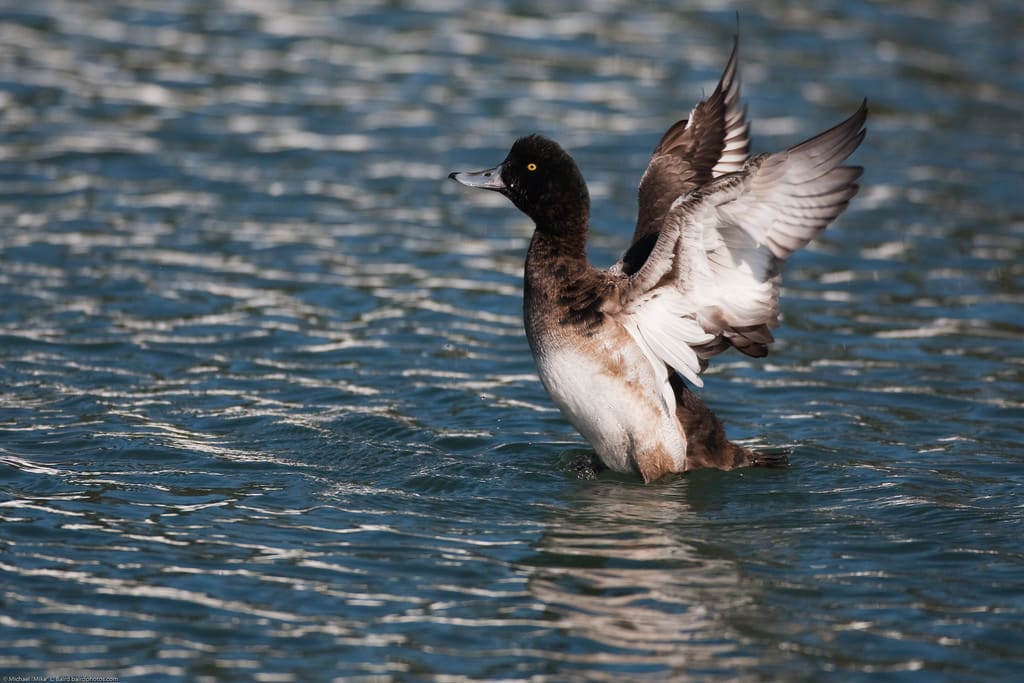
The male has a dark head with a green sheen, a black breast, a light back, a black tail, and a white underside. The drake or male greater scaup is larger and has a more rounded head than the female. The drake's belly and flanks are a bright white. Its neck, breast, and tail feathers are a glossy black, while its lower flanks are vermiculated gray. The upper wing has a white stripe starting as the speculum and extending along the flight feathers to the wingtip. Legs and feet of both sexes are gray. The adult female has a brown body and head, with white wing markings similar to those of the male but slightly duller. It has a white band and brown oval shaped patches at the base of the bill, which is a slightly duller shade of blue than the drake's.
Taxonomy
- Kingdom
- Animalia
- Phylum
- Chordata
- Class
- Bird
- Family
- Anatidae
- Genus
- Aythya
- Species
- marila
Habitat
Female greater scaup have a single pitch, a raspy “arrr-arrr-arrr-arrr-arrr” vocalization. The courtship is complex and results in the formation of monogamous pairs. Pairs nest in close proximity to each other in large colonies, usually near water, on an island or shoreline, or on a raft of floating vegetation. The nest consists of a shallow depression made by the female and lined with her down.After the female lays the eggs, the drake abandons the female and goes with other drakes to a large, isolated lake to molt. These lakes can be close to the breeding grounds or miles away. The lakes chosen are used yearly by the same ducks. The optimal molting lake is fairly shallow and has an abundance of food sources and cover. The female lays six to nine olive-buff-colored eggs,
Diet
The greater scaup dive to obtain food, which they eat on the surface. They mainly eat molluscs, aquatic plants, and aquatic insects. During the summer months, the greater scaup will eat small aquatic crustaceans. There is a report of four greater scaups in April near Chicago swallowing hibernating leopard frogs (with body length about 5 cm (2.0 in)), which they dredged out of a roadside freshwater pond. In freshwater ecosystems, the greater scaup will eat seeds, leaves, stems and roots, along with sedges, pondweeds, muskgrass, and wild celery.
Behavior
Owing to the greater scaup's webbed feet and weight, it can dive up to 6 metres (20 ft) and stay submerged for up to a minute, allowing it to reach food sources that are unobtainable to other diving ducks. The greater scaup forms large flocks, some of which can contain thousands of birds. When flocks are on flowing water, they will face the current, and as the ducks float backwards, some fly to the front of the flock to maintain position..The greater scaup has a circumpolar distribution, breeding within the Arctic Circle both in the Old World (the Palearctic) and in North America (the Nearctic). It spends the summer months in Alaska, Siberia, and the northern parts of Europe. It is also found in Asia and is present in the Aleutian Islands year round.The summer habitat is marshy lowland tundra and islands in fresh water lakes. In the fall, greater scaup populations start their migration south for the winter. They winter along the Pacific and Atlantic coasts of North America, the coasts of northwest Europe, the Caspian Sea, the Black Sea, the coast of Japan, Yellow Sea and East China Sea. During the winter months, they are found in coastal bays, estuaries, and sometimes inland lakes, such as the lakes of Central Europe and the Great Lakes.
Hunting
Typically hunted with a 12 ga shotgun. Shot size #2-4 is sufficient. Effectively hunted with decoys and calling. Dogs are used for bird retrieval. Steel shot is required for waterfowl in the United States.
Conservation Status
Listed as Least Concern by IUCN.