
Overview
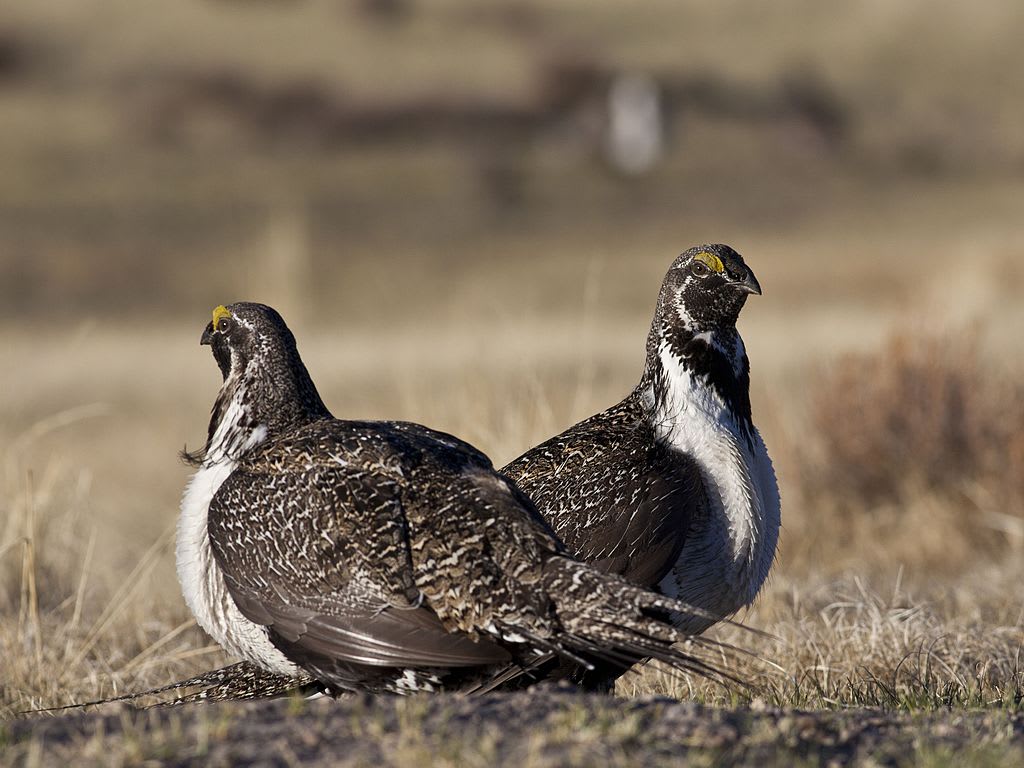
long, pointed tail and legs with feathers to the toes. The adult male has a yellow patch over each eye, is grayish on top with a white breast, and has a dark brown throat and a black belly; two yellowish sacs on the neck are inflated during courtship display. The adult female is mottled gray-brown with a light brown throat and dark belly
Taxonomy
- Kingdom
- Animalia
- Phylum
- Chordata
- Class
- Bird
- Family
- Phasianidae
- Genus
- Centrocercus
- Species
- urophasianus
Habitat
Greater sage-grouse are obligate residents of the sagebrush ecosystem, usually inhabiting sagebrush-grassland or juniper sagebrush-grassland communities. Meadows surrounded by sagebrush may be used as feeding grounds. Use of meadows with a crown cover of silver sagebrush is especially important in Nevada during the summer.
Diet
Sage grouse are highly selective grazers, choosing only a few plant genera. Dandelion, legumes (Fabaceae), yarrow (Achillea spp.) and wild lettuce (Lactuca spp.) account for most of their forb intake. From July to September, dandelion comprised 45% of forb intake; sagebrush comprised 34%.Collectively, dandelion, sagebrush, and two legume genera (Trifolium and Astragalus) contributed more than 90% of the greater sage-grouse diet. Insects are a minor diet item for adults. Insects comprised 2% of the adult diet in spring and fall and 9% in summer. Sagebrush made up 71% of the year-round diet.
Behavior
A permanent resident in its breeding grounds but may move short distances to lower elevations during winter. It makes use of a complex lek system in mating and nests on the ground under sagebrush or grass patches. It forages on the ground, mainly eating sagebrush but also other plants and insects. They do not have a muscular crop and are not able to digest hard seeds like other grouse.
Hunting
Upland game bird most effectivly hunted with a bird dog. A true gentlemans bird.
Conservation Status
Listed as Near Threatened. Population reduced from 16 million to 200,000 over last 100 years. This birds can only survive where sagebrush grows. by IUCN.