
Overview
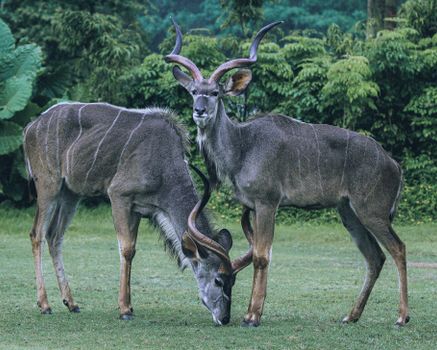
A large, elegant antelope with long legs, a hump on its shoulders, and magnificent corkscrew-shaped horns. Its color is gray to reddish-brown, with white stripes, and there is a white facial chevron. A brown mane continues as a white dorsal crest, and there is a fringe of long brown and white hairs from chin to brisket. The horns (males only) are long and keeled, growing upward in 2-3 open spirals. Females are similar but hornless.
Taxonomy
- Kingdom
- Animalia
- Phylum
- Chordata
- Class
- Mammal
- Order
- Artiodactyla
- Family
- Bovidae
- Genus
- Tragelaphus
- Subspecies
- Tragelaphus strepsiceros strepsiceros, Tragelaphus strepsiceros cottoni, Tragelaphus strepsiceros chora
Habitat
Savanna areas, often in rocky hills, mixed scrub woodlands. The greater kudu is one of the few large mammals that prefer living in settled areas—in scrub woodland and bush on abandoned fields and degraded pastures, mopane bush and acacia in lowlands, hills and mountains. They will occasionally venture onto plains only if there is a large abundance of bushes, but normally avoid such open areas to avoid becoming an easy target for their predators.
Diet
Primarily browses but will graze readily. Consists of leaves, grass, shoots and occasionally tubers, roots and fruit (they are especially fond of oranges and tangerines). They feed and drink in the early morning and late afternoon, acquiring water from waterholes or roots and bulbs that have a high water content.
Behavior
They may be active throughout the 24-hour day. Herds disperse during the rainy season when food is plentiful. During the dry season, there are only a few concentrated areas of food so the herds will congregate. Greater kudu are not territorial; they have home areas instead. Male kudu may form small bachelor groups, but they are more commonly found as solitary and widely dispersed individuals. Solitary males will join the group of females and calves, usually 6-10 individuals per group, only during the mating season. Like many other antelope, male kudus can be found in bachelor groups, but they are more likely to be solitary. Their dominance displays tend not to last long and are generally fairly peaceful, consisting of one male making himself look big by making his hair stand on end. When males do have a face-off, they will lock their horns in a competition to determine the stronger puller; kudus' necks enlarge during the mating season for this reason. Sometimes two competing males are unable to unlock their horns and, if unable to disengage, will die of starvation or dehydration. Males are seen with females only in the mating season, when they join in groups of 5–15 kudus, including offspring.
Hunting
The breeding season is in May and this is an excellent time to hunt them as they are very active and distracted by females. Spot and stalk methods with a mid to heavy caliber or hunting over a watering source where legal. Usually taken with calibers such as 25-06 up to .416's. with your best choice being around the .300 win mag range. Tracking this animal is a possibility due to it being one of the heavier African species. When bowhunting treat this animal as you would a bull elk with a minimum recommended pull weight of 50 lbs, tough broadhead, and a medium-heavy arrow. They may jump string, but not to the degree of other plains game such as impala. They can be very skittish, and once frightened are extremely hard to follow up on. A 60 inch bull is known as the Holy Grail of trophy Greater kudu. You can hunt a Southern greater kudu in Botswana, Mozambique, Namibia, Zambia, Zimbabwe, Tanzania, and South Africa. If you are interested in the SCI record book, a Southern greater kudu turns into an Eastern Cape greater kudu for the record book category only if you are hunting one in the Eastern Cape Province. This separate record book category is due to the specimens of the Eastern Cape to be overall generally smaller in horn size to other Southern greater kudu specimens. You can hunt the Western greater kudu in Chad and the northeast corner of the Central Africa Republic (CAR) and the Northern greater kudu in the lowlands of Ethiopia and Karamoja region of Uganda. Quote- There is something about this lovely beast that makes him a hunter's grail. Perhaps it is the tremendous sweep of those double-curling horns, as brown and clean as rubbed mahogany, heavy-ridged from the base around the curls, and ending in polished ivory points. Perhaps it is the chevron on the nose, or his clean, gray, white-barred hide, the skin thin as parchment. Perhaps it is the delicacy of his long-legged deer's body, slimness of his deer's legs, the heavy-maned swell of his neck, the enormity of his ears that pick up whispers at radar range. ...The kudu is just under your hand, and yet he always manages to escape you. Robert Ruark, Horn of the Hunter
Conservation Status
Listed as Least Concern by IUCN.