
Overview
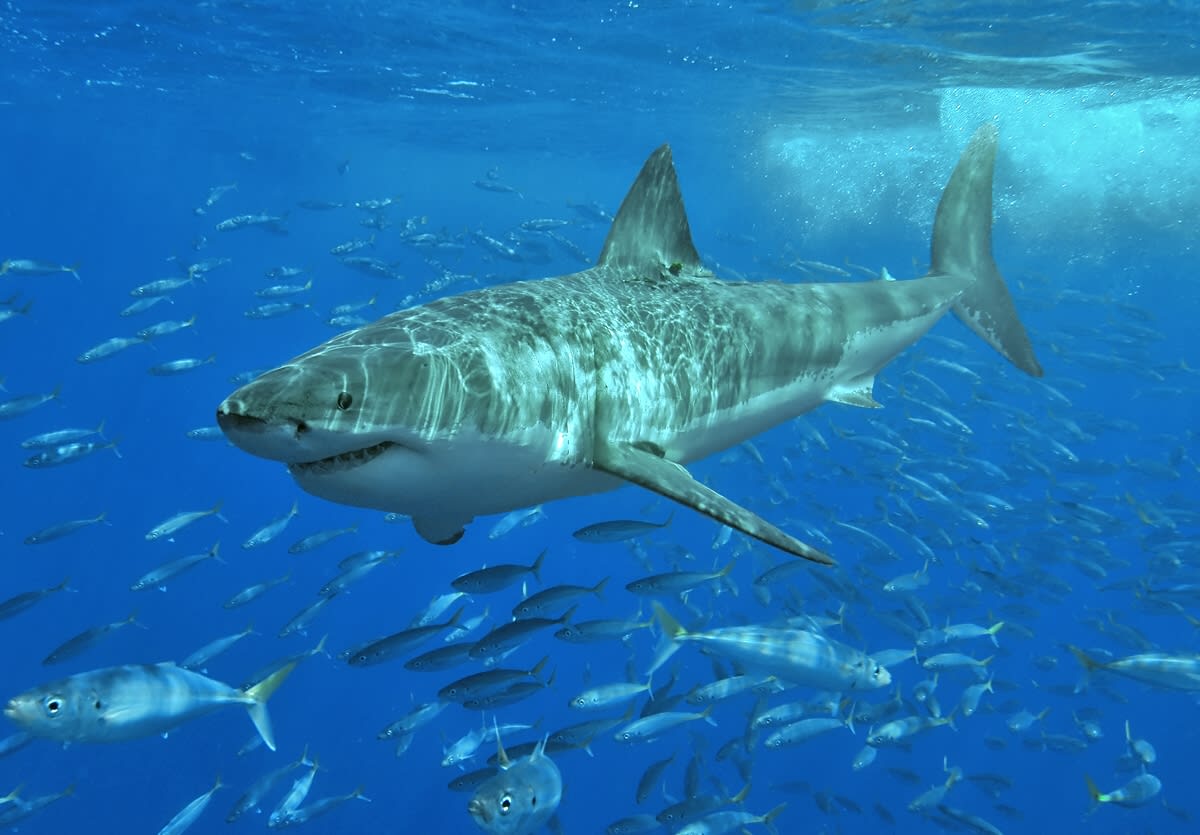
The snout is conical and ends in a point, hence the name “white pointer”. There is a large, very prominent, flattened keel on either side of the caudal peduncle. It can be distinguished from all other sharks by its teeth, which are large and triangular like stone arrowheads, with sharp, serrated cutting edges. The great “white” shark is actually a grayish brown color above, fading to an off white on the belly. The pectoral fins are black tipped, and there is a black oval spot on the body just above them.
Taxonomy
- Kingdom
- Animalia
- Phylum
- Chordata
- Class
- Chondrichthyes
- Order
- Myliobatiformes
- Family
- Lamnidae
- Genus
- Carcharodon
- Species
- carcharias
Habitat
Though basically a deep water oceanic species, it does come in fairly close to shore off California because of the cool current and to feed on marine mammals. It also frequents Australian and South African beaches and is suspected of entering saltwater creeks.
Diet
Its diet includes fish, squid and other sharks as well as sea turtles, seals, sea lions, and sea gulls. This shark has attacked small boats, sometimes sinking them, and has been known to take a larger boat by the propeller and shake it.
Behavior
Great white sharks are primarily solitary hunters that migrate long distances across oceans in search of food. They exhibit curiosity by investigating unfamiliar objects and are known for breaching the surface when attacking prey. Their activity peaks at dawn and dusk, and they are not highly territorial but may compete aggressively for food.
Fishing
Fishing methods include bait fishing with large fish chunks while chumming and also trolling. It is probably the most dangerous of all sharks as far as size, strength, ability and disposition to attack are concerned. The flesh is edible, though rarely eaten.
Conservation Status
Listed as Vulnerable by IUCN.