
Overview
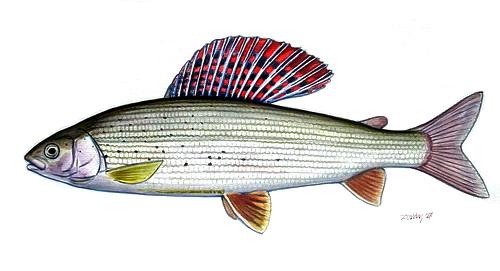
Like its North American counterpart, it is easily recognized by its distinctive sail like dorsal fin, which is followed by a small adipose fin that identifies this fish as a salmonid. A stikingly colored fish; the dorsal surface is steel blue shading to silvery-green on the sides and silver ventrally. The sides of the body have stripes of violet and in breeding season, the colors are heightened with the dorsal fin having an orange-red margin.
Taxonomy
- Kingdom
- Animalia
- Phylum
- Chordata
- Class
- Actinopterygii
- Order
- Perciformes
- Family
- Salmonidae
- Genus
- Thymallus
- Species
- thymallus
Habitat
The Grayling is a river fish and prefers clear, well-oxygenated water in the upper reaches of rivers with sand or gravel bottom. It also occurs in lakes, especially in mountain regions and rarely in brackish water (Baltic).
Diet
Grayling feed mainly on bottom-living insects larvae, especially sedentary caddis worms and the larvae and pupae of midges.
Behavior
Grayling are often found in schools in clear, flowing waters, making them social fish that prefer cooler temperatures. They are most active during the day, feeding near the surface or bottom, and exhibit territorial behavior during spawning seasons. Males may aggressively defend spawning areas from rivals.
Fishing
It is considered a good game –fish with fly and spinner in Europe. They are a good food fish and highly esteemed in parts of Europe, but is best prepared and eaten fresh as its special flavor is lost a few hours after death. The name thymallus refers to the thyme-like scent of the fish.
Conservation Status
Listed as Least Concern by IUCN.