
Overview
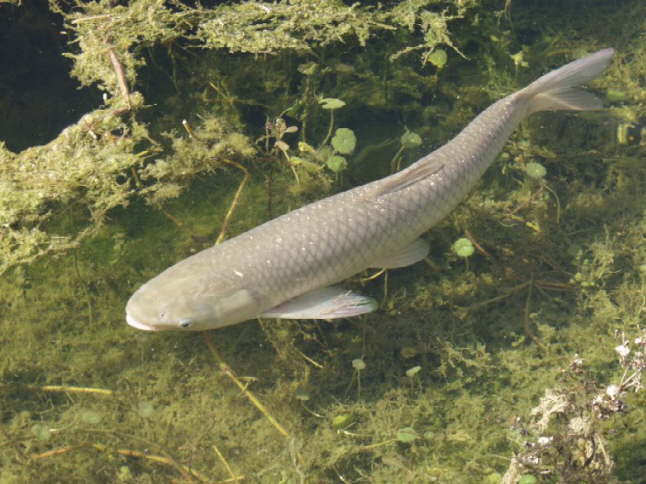
The grass carp is one of the largest members of the minnow family. The body is oblong with moderately large scales, while the head has no scales. There are three simple and seven branched rays on the dorsal fin. Grass carp are silvery to olive in color, lacking the golden hue of common carp, and they have no barbels. The species shows a high tolerance for salinity; specimens have been known to survive for several days in water up to three times as salty as sea water.
Taxonomy
- Kingdom
- Animalia
- Phylum
- Chordata
- Class
- Actinopterygii
- Order
- Lophiiformes
- Family
- Cyprinidae
- Genus
- Ctenopharyngodon
- Species
- idella
Habitat
This species occurs in lakes, ponds, pools, and backwaters of large rivers, preferring large, slow-flowing or standing water bodies with vegetation. In the wild, grass carp spawn in fast-moving rivers, and their eggs, which are slightly heavier than water, develop while drifting downstream, kept in suspension by turbulence.
Diet
Their feeding habits make them ideal as vegetation control agents, as they are capable of consuming 40% to 300% of their body weight per day in plant material.
Behavior
Typically, spawning occurs in the spring when water temperatures reach 59-63°F, and under rising water conditions. Eggs are semi-pelagic and must remain suspended during the 20-40 hour incubation period. Therefore, long river stretches are usually necessary for successful spawning. Once young grass carp reach approximately three inches in length, they become nearly 100% herbivorous.
Fishing
While the grass carp might be reluctant to bite, once hooked they are strong fish that put up a tenacious fight and are known to jump. In some countries, grass carp are an integral part of fish culture and form an important source of fish protein for human consumption. (See also Common Carp). Grass carp are potentially harmful to native resources. Currently, only triploid (sterile) grass carp are legal for use in Texas, and a permit is required to obtain them. Although, the herbivorous feeding habits of this species make it very difficult to catch.
Conservation Status
Listed as Not Evaluated by IUCN.