
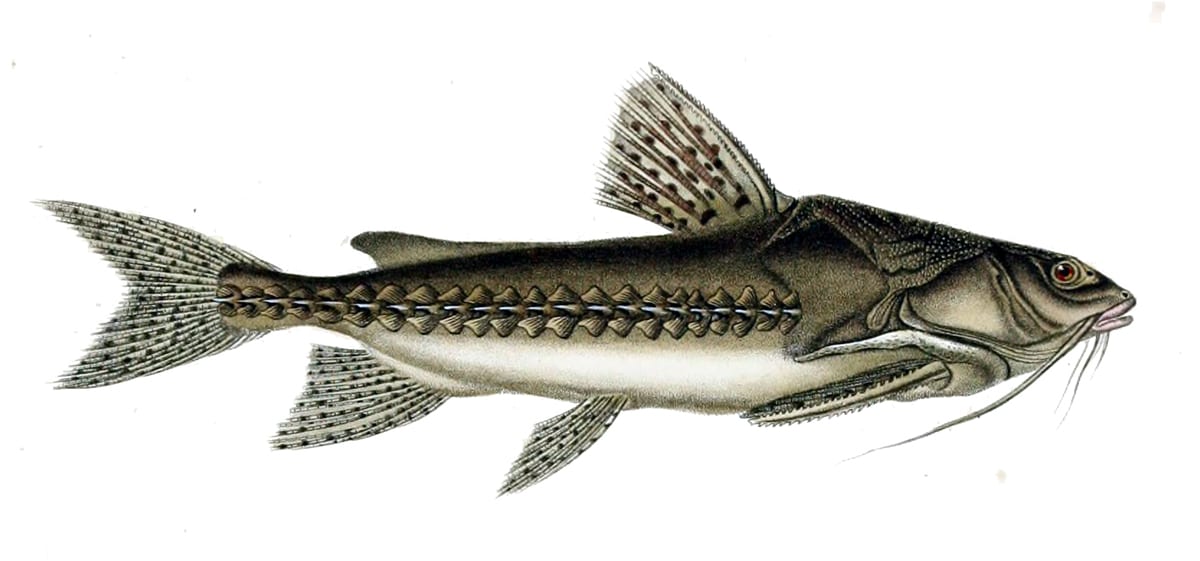
Taxonomy
- Kingdom
- Animalia
- Phylum
- Chordata
- Class
- Actinopterygii
- Order
- Perciformes
- Family
- Doradidae
- Genus
- Pterodoras
- Species
- granulosus
Habitat
This species inhabits large rivers and their tributaries in South America, such as the Amazon, Paraná, and Guyana River drainages, preferring slow-moving or standing waters with muddy or sandy bottoms. It is often found in floodplain areas and near submerged vegetation, thriving in warm, freshwater environments.
Diet
The granulated catfish is omnivorous, feeding primarily on benthic invertebrates like insects and crustaceans, as well as small fish and plant matter. It forages mainly at night on the river bottom using its barbels to detect food, and it may scavenge dead organic material.
Behavior
This catfish is primarily nocturnal, spending days hiding in crevices or under debris and becoming active at night to hunt or scavenge. It is generally solitary but may form loose groups in favorable habitats, and it exhibits territorial behavior when defending feeding areas. They are bottom-dwellers that use their barbels for navigation and locating prey in low-visibility waters.
Fishing
Targeting the granulated catfish (Pterodoras granulosus) in South America's vast river systems like the Amazon, Paraná, and Guyana drainages offers exciting opportunities for anglers while supporting conservation through regulated fishing practices that fund habitat protection. Use bottom-fishing techniques with stout rods and reels to handle their powerful runs in slow-moving waters with muddy or sandy bottoms, focusing on areas near submerged vegetation or floodplains where they forage at night; employ a 7-9 foot medium-heavy rod paired with 20-30 lb test line, a strong egg sinker rig, and size 2/0 to 5/0 hooks to keep bait on the bottom. Opt for natural baits such as nightcrawlers, cut bait from small fish, or shrimp to mimic their diet of benthic invertebrates and small prey, as these are highly effective for attracting bites in low-visibility conditions. The best season aligns with the rainy period from November to April, when rising waters trigger increased activity, and prime fishing occurs at night or dusk for their nocturnal feeding habits. Focus on deeper holes and structure-rich habitats to increase your chances of landing these robust fish, which can reach record sizes up to 120 cm (about 47 inches) and weights of 15 lbs 8 oz, though exact IGFA records are not prominently documented. Conservation-wise, angler-funded programs in the Amazon basin help maintain healthy populations through catch-and-release practices and slot limits in certain areas, ensuring sustainable fisheries that protect these waterways and support broader aquatic ecosystem restoration efforts.
Conservation Status
Listed as Not Evaluated by IUCN.