
Overview
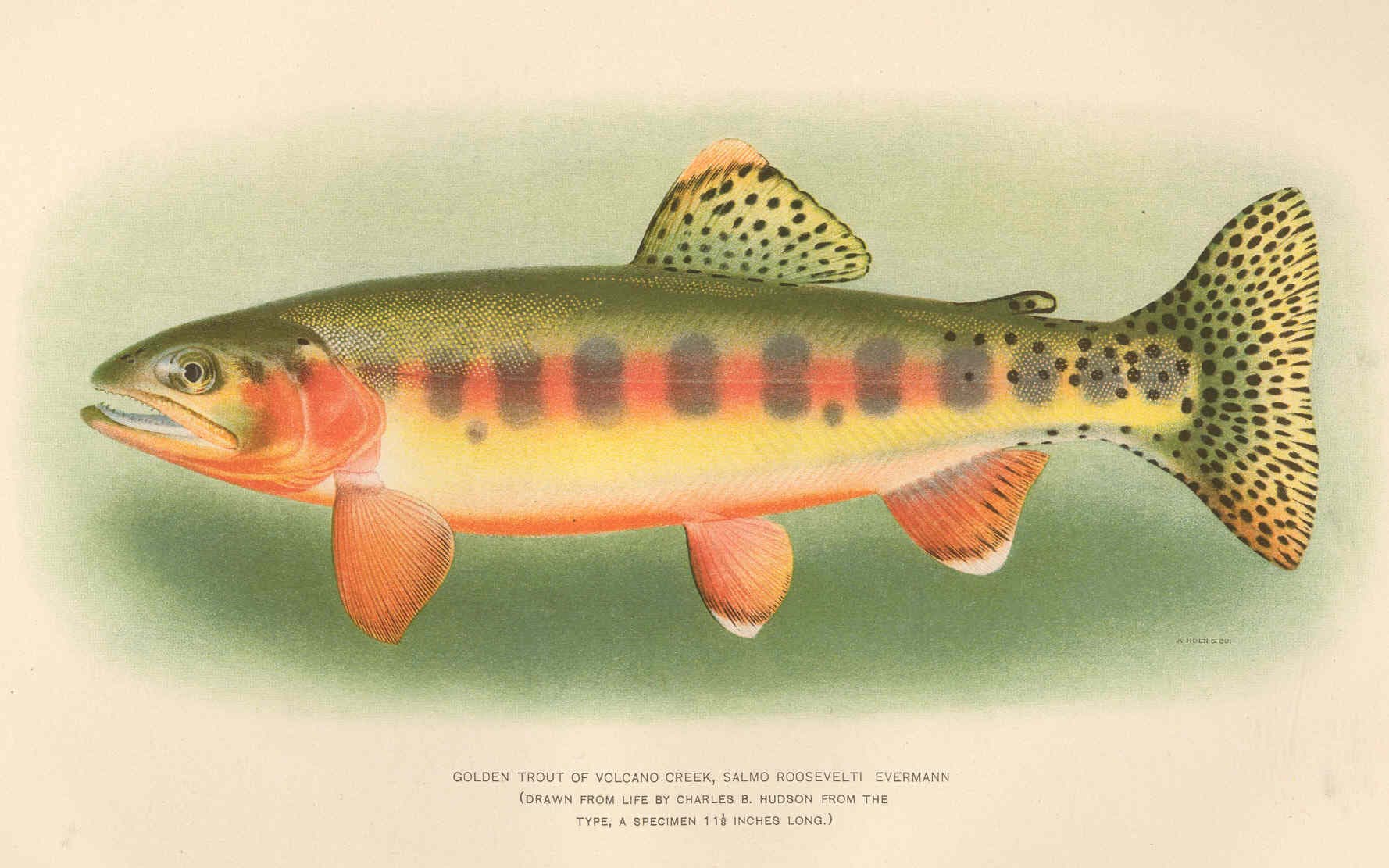
Due to its coloration and markings it is considered one of the most beautiful of all freshwater game fishes. It is the only species of Salmonidae in which the parr marks on the sides typically remain prominent throughout life rather than disappearing at an early age. A red streak similar to that of a rainbow trout runs along the sides through the ten or so parr marks. The tail is golden yellow (as is most of the body) and is covered with large black spots that radiate outward toward the edge as in the rainbow, cutthroat, and some other closely related species. Usually the posterior part of the body is heavily spotted. The forward part of the body may have spots above the lateral line on the back and top of the head, but not always. The upper fins are golden yellow and heavily spotted. The lower fins are orangish or reddish with no spots. The dorsal fin and the ventral and anal fins have white tips (in some specimens) that are often separated from the rest of the fin by a broad black line. The sides of the head and “throat” are a blend of rosy red and golden yellow. When this species is brought down from its high altitude habitat and propagated at low altitudes, it loses its brilliant colors and becomes steely blue.
Taxonomy
- Kingdom
- Animalia
- Phylum
- Chordata
- Class
- Actinopterygii
- Order
- Perciformes
- Family
- Salmonidae
- Genus
- Oncorhynchus
- Species
- aguabonita
Habitat
Usually found in small streams, lakes, ponds, rivers, or clear pools in elvations higher than 5,000 ft.
Diet
Insects, small larvae, midges, caddiesflies, and some small crustaceans.
Behavior
Golden trout are fairly social and tend to be seen in schools.
Fishing
It is considered to be a highly desirable and almost mystical species. Fly fishermen and other anglers have to match their lures to the types of food items available at the high altitudes where the golden trout occurs. Caddisflies and midges are most effective, through goldens have been caught with spoons, spinners, worms, salmon eggs, small crustaceans, and various small insects. The flesh is slightly oilier than most trouts, but firm, ifnely textured, and delicious but does not keep for extended periods.
Conservation Status
Listed as Not Evaluated by IUCN.