
Overview
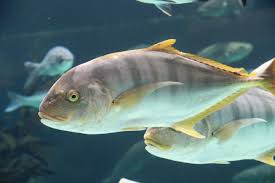
The coloration sets this fish apart from other species of trevallies. In juveniles the color tends to be golden with the belly and sides flushed with beautiful metallic yellow, usually broken by vertical, alternating broad and narrow black bars. This color and the bars tend to fade with age, with the bars deterioating into a few black blotches in specimens over 50 cm (19.7 in). The golden trevally is also distinguished by large fleshy lips and lack of descernible teeth.
Taxonomy
- Kingdom
- Animalia
- Phylum
- Chordata
- Class
- Actinopterygii
- Order
- Cichliformes
- Family
- Carangidae
- Genus
- Gnathanodon
- Species
- speciosus
Habitat
Golden trevally have a wide international distribution, extending from the Indo-Pacific eastward to the Americas where they are found from Baja, California to Ecuador. This species occurs in deep lagoon and seaward reefs.
Diet
They feed by rooting for crustaceans and other invertebrates in the sand. It also feeds on small fishes. Small juveniles live among the tentacles of jellyfish.
Behavior
The golden trevally frequently forms schools and is known to swim closely around sharks and other large fish, to gain protection from likely predators.
Fishing
Golden trevally are sportfish that are highly regarded by anglers and respond to a wide range of baits and flies. While they will readily take surface lures, golden trevallies are not surface fighters, they tend to stay down deep and will not give up until tired. If this trevally is kept for the table, it should be bled, gutted, filleted and iced down as soon as possible.
Conservation Status
Listed as Least Concern by IUCN.