
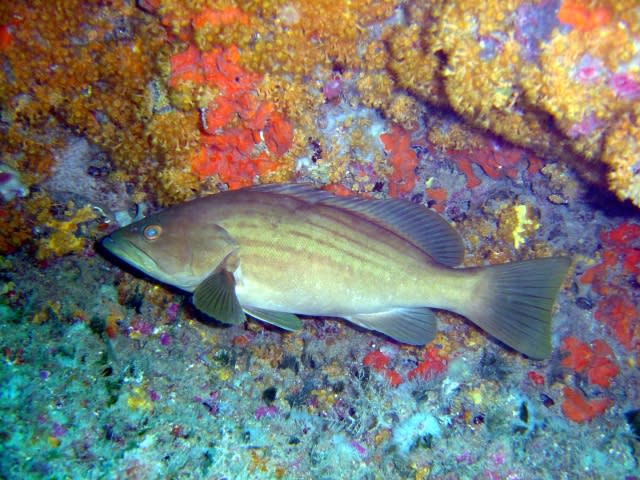
Taxonomy
- Kingdom
- Animalia
- Phylum
- Chordata
- Class
- Actinopterygii
- Order
- Scorpaeniformes
- Family
- Serranidae
- Genus
- Epinephelus
- Species
- costae
Habitat
Goldblotch groupers inhabit rocky and coral reefs in the eastern Atlantic Ocean and Mediterranean Sea, often in depths from 10 to 200 meters. They prefer areas with crevices, caves, and structures for shelter, avoiding open sandy bottoms.
Diet
This species primarily feeds on small fish, crustaceans like crabs and shrimp, and cephalopods such as squid. It employs an ambush strategy, hiding among rocks and striking quickly at prey, with feeding most active during dawn and dusk.
Behavior
Goldblotch groupers are solitary and territorial, aggressively defending their reef areas from intruders. They are primarily nocturnal but can be active during the day, using camouflage to hunt; they also exhibit protogynous hermaphroditism, starting as females and changing to males.
Fishing
Target the Goldblotch grouper, a prized sport fish in the eastern Atlantic and Mediterranean, using effective bottom fishing or jigging techniques to mimic its ambush predation style—drop baits near rocky reefs and structures at depths of 10-200 meters for the best results. Opt for medium-heavy tackle, including a 7- to 9-foot rod with a strong reel spooled with 20-50 lb test line, paired with circle hooks and leaders to handle its powerful runs; bait options include live shrimp, small fish, or squid, while jigs and soft plastic lures that imitate crustaceans excel for attracting strikes. The prime season runs from summer during spawning aggregations, with dawn and dusk offering the most action as the fish are most active; focus on areas like the Mediterranean Sea or off the coasts of Algeria and Egypt for consistent catches. Record sizes reach up to 1 meter in length and 2 lbs 15 oz, supporting its status as a challenging quarry—check IGFA records for regional accolades that highlight conservation successes. As a data-deficient species per IUCN, Goldblotch grouper populations are managed through angler-funded programs that promote catch-and-release and slot limits, ensuring healthy stocks and protecting vital reef habitats, all while recreational fishing contributes to conservation via license fees and habitat restoration efforts.
Conservation Status
Listed as Data Deficient by IUCN.