
Overview
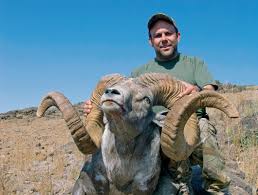
It is one of the larger argali subspecies with the horns being similar to those of an Altay argali, nearly as massive, but a little shorter. This animal does not grow a neck ruff and has relatively long legs. The upper parts of the coat are a variegated yellowish-brown; the flanks and front of thighs are a more uniform darker brown. The sides are buff, the rump patch light buff and diffuse, the tail has a brown center line, the belly is whitish, and the muzzle, sides of face and upper throat, are a grizzled grayish-brown. Females are considerably smaller, sometimes weighing less than half as much as males.
Taxonomy
- Kingdom
- Animalia
- Phylum
- Chordata
- Class
- Mammal
- Order
- Artiodactyla
- Family
- Bovidae
- Genus
- Ovis
- Species
- Argali, ammon
Habitat
High altitude desert climates. Habitat varies according to geographic location, but includes mountains, steppe valleys, rocky outcrops and open deserts.
Diet
Desert grasses and forbs are the staple for this sub-species. Argali eat 35–42 lbs (16–19 kg) of food a day. The vegetation preferred by the species varies based on elevation and area. In higher elevations, they predominantly eat grasses, sedges, and forbs. At midelevation habitats, they more regularly feed on bushes and mesophyte grasses. In the lowest ranges and the spurs of deserts, grasses and sedges again predominate, but often of different species than the high-elevation ones. Water is needed by argali, which is rarely a problem for animals living at high elevation, where melting snow and small waterways are regularly encountered. In drier climes, argali may travel several kilometers in search of water. When available, argali readily consume saline soil.
Behavior
Argali live in herds typically numbering up to 150 animals, segregated by sex, except during the breeding season. Some rams are solitary, but most are seen in small herds numbering between up to 30 individuals. Females and their young live in larger groups, regularly up to 90 individuals and sometimes up to 200 animals. Migrating herds, especially those made up of males, have been reported. Most migration appears to be related to seasonally decreased food sources, an overabundance of biting insects (especially gadflies), severe drought or fires, poaching by humans, and competition with domestic livestock. With their long legs, these animals can travel quickly from place to place. Argali tend to live at higher elevations during the summer. These sheep are calm and gregarious with one another. They are fast runners.
Hunting
Makes for a tough hunt amid typically rocky terrain. Local horses are easy to handle and well adapted to high altitudes. Traveling on horseback enables one to cover longer distances, with less physical pain, in search of the perfect ram.
Conservation Status
IUCN does not have a conservation status for this particular subspecies. More information is needed regarding current conservation efforts and the best way forward for future conservation of the species.