
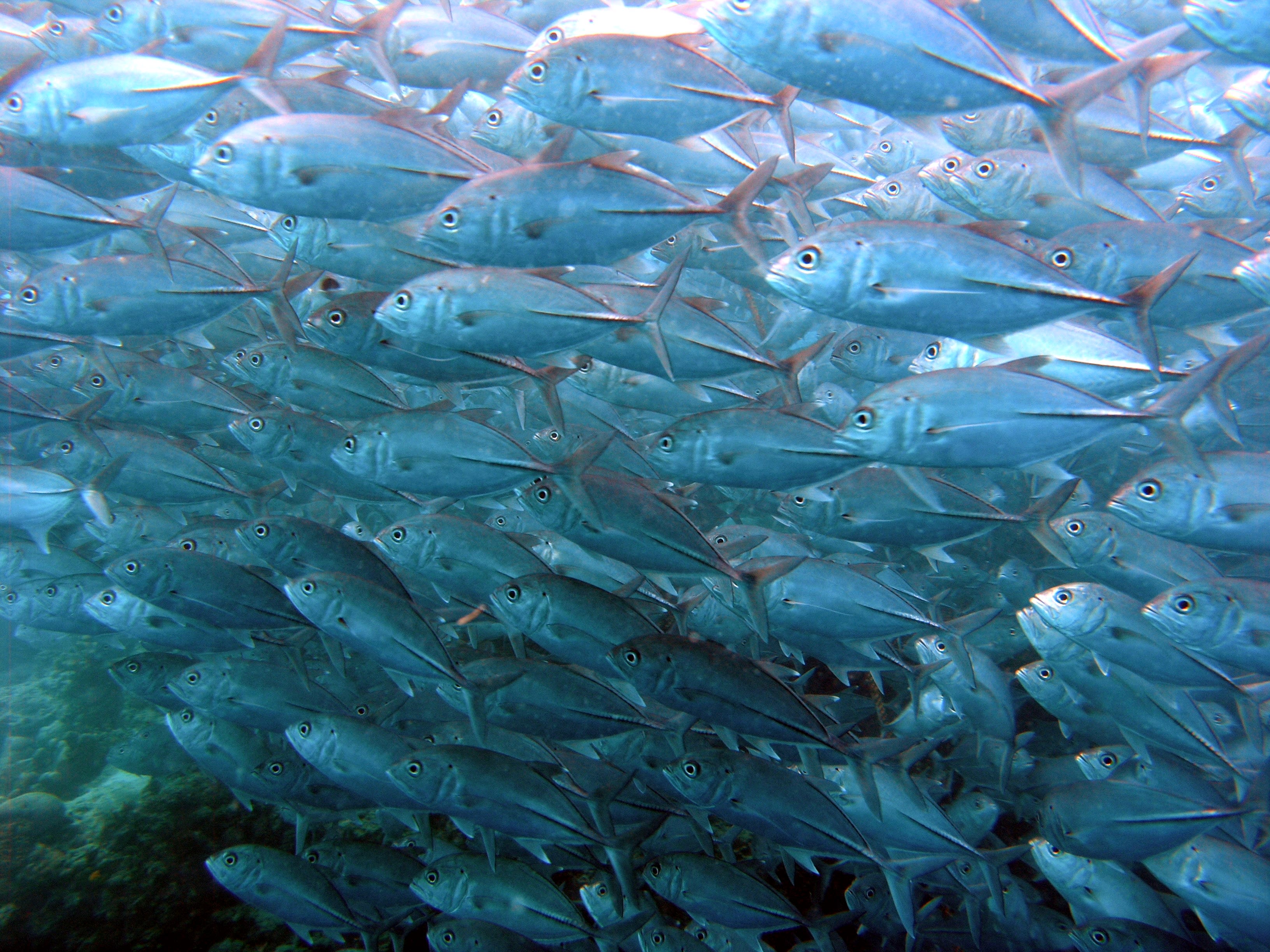
Overview
It has a small oval shaped patch of scales in the center of the larger scaleless area on the breast in front of the ventral fins, distinguishing it from the bigeye trevally (Caranx (Caranx) sexfasciatus) whose breast is fully scaled. In some specimens (about 5%) this oval patch of scales is extensive enough to make detection of the scaleless area difficult. The body and head are usually very deep with a blunt snout. The lateral line is strongly curved anteriorly. The straight portion is covered with scutes; 25 33 in the giant trevally and 28 37 in the bigeye. The first dorsal fin consists of 8 spines, the second of 17 21 soft rays, and anal fin of 3 spines and 15 17 soft rays. Gill rakers on the first arch total 18 23. There is no spot on the operculum such as is found on the bigeye trevally, nor is there a spot at the base of the pectoral fins such as appears on the crevalle jacks (Caranx hippos and Caranx caninus), the close Atlantic and eastern Pacific relatives of this species.
Taxonomy
- Kingdom
- Animalia
- Phylum
- Chordata
- Class
- Actinopterygii
- Order
- Cichliformes
- Family
- Carangidae
- Genus
- Caranx
- Species
- sexfasciatus
Habitat
Inhabits coral and rock reefs in warm coastal waters of the Indian and central Pacific Oceans, eastward to the Hawaiian and Marquesas Islands. Common in the waters off Kenya and other parts of Africa as well as off Australia, New Zealand, the Philippines, Malaysia, and Hawaii. This is the most common of the trevallys found in Hawaii's and Kenya's waters. Adults are sedentary, prefer rocky areas near shore or outside reef drop offs.
Diet
Giant trevally primarily feed on fish such as sardines, mackerel, and mullets, as well as cephalopods like squid and crustaceans including crabs and shrimp. They are ambush predators that hunt in schools or individually, often targeting prey near reefs or in open water. Feeding activity peaks at dawn and dusk when visibility is low.
Behavior
Feed most actively at night.
Fishing
Hawaiian anglers report that the darker the night the more actively they feed. It is a highly rated sport fish in the waters of Hawaii and Kenya both for its large size and for the hard fight it gives. Fishing methods include surf fishing, drifting, or still fishing using live or cut baits. Trolling with baits and lures can also bring results. Baits and lures include mullet, herring, sauri, garfish, anchovy, squid, cut strip baits, Konaheads, knuckleheads, bulletheads, feathers, plastic jigs, plastic fish and squids, drone spoons, and rope lures. The pinkish flesh is highly esteemed as food in some areas and is also frequently used for strip baits, cut baits or chum.
Conservation Status
Listed as Least Concern by IUCN.