
Overview
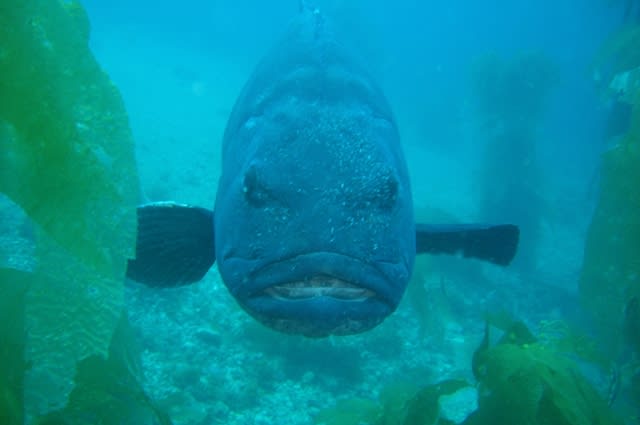
The first dorsal fin is very low and consists of 11 spines. The second dorsal fin is higher than the first, and consists of 10 soft rays. The presence of more dorsal spines than soft rays distinguishes the giant sea bass from any similar related species, including the jewfish, Epinephelus itajara. All the fins are black (though the ventral fins appear lighter because the white membrane shows clearly between the black spines). Juveniles are brick red with conspicuous dark spots and a few pale yellow blotches on the body; the fins are black or transparent.
Taxonomy
- Kingdom
- Animalia
- Phylum
- Chordata
- Class
- Actinopterygii
- Order
- Perciformes
- Family
- Polyprionidae
- Genus
- Stereolepis
- Species
- gigas
Habitat
Occurs in tropical and subtropical inshore waters of the northeast Pacific off the California and Mexican coasts. Also known on the Asiatic Pacific coast. Despite its great size, the giant sea bass is an inhabitant of near shore waters, particularly over hard, rocky bottoms and around kelp beds. The young can be found in depths of about 6 to 15 fathoms. Larger specimens can generally be found in depths of 15 to 25 fathoms.
Diet
Diet includes crustaceans and a wide variety of fishes. Mackerel, sheephead, whitefish, sand bass, and several types of crab also make up the sea bass's diet.
Behavior
Giant sea bass can be very curious, and are known to swim near divers to investigate them. They spend much of its time in kelp forests and rocky reefs waiting to ambush prey. Although the majority of their time is spent moving slowly, despite their size they can move very quickly for a short time. They have even been reported aiming faster than bonito over short distances. Four individuals have been tracked migrating annually between Anacapa and Catalina islands, a distance of 50 nautical miles, in about 27 hours.
Fishing
Fishing methods are live or dead bait fishing from an anchored or drifting boat with large natural baits. Fishing is best in the 10 to 25 fathom range.
Conservation Status
Listed as Cridically Endangered (IUCN 3.1). Giant sea bass populations are believed to be increasing slowly after years of decline but there is no scientific evidence to that effect. They are listed internationally as critically endangered and are protected in California. by IUCN.