
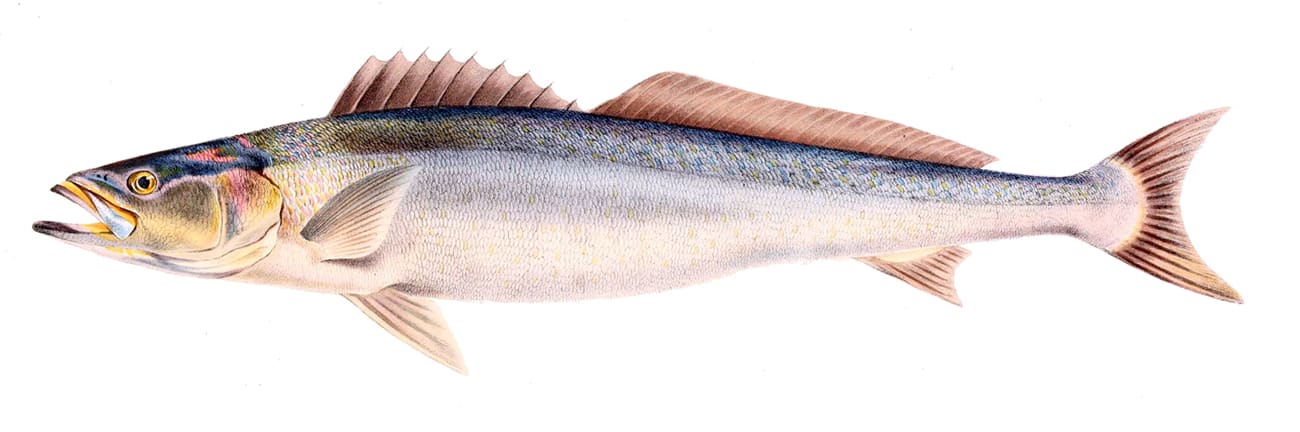
Taxonomy
- Kingdom
- Animalia
- Phylum
- Chordata
- Class
- Actinopterygii
- Order
- Perciformes
- Family
- Sciaenidae
- Genus
- Atractoscion
- Species
- aequidens
Habitat
Geelbek primarily inhabit coastal waters, estuaries, and continental shelves in the Atlantic and Indian Oceans, often over sandy or muddy bottoms. They prefer depths ranging from 10 to 200 meters and are commonly found near South Africa, Angola, and Australia. These areas provide ample prey and shelter from stronger currents.
Diet
Geelbek are carnivorous predators that feed mainly on smaller fish like sardines and anchovies, as well as crustaceans such as prawns and crabs, and occasionally squid. They hunt in schools, using ambush tactics during dawn and dusk when visibility is low. Feeding behavior includes rapid chases and strikes in open water.
Behavior
Geelbek are schooling fish that form large groups for protection and feeding, often migrating seasonally along coastlines. They are most active during twilight hours, exhibiting territorial behavior around prime feeding spots, and can be cautious when approached by boats. These fish are known for their strong swimming capabilities and vocalizations, producing drumming sounds to communicate.
Fishing
Geelbek (Atractoscion aequidens) is a prized sport fish in regions like South Africa, Angola, and Australia, offering exciting challenges for anglers and contributing to conservation through license fees that fund habitat restoration and population monitoring programs. Target them using trolling with diving plugs or metal jigs to mimic their prey like sardines and anchovies, or bottom fishing with live bait such as prawns and crabs for effective strikes in their schooling environments. Opt for medium-heavy to heavy tackle, including a sturdy rod (7-9 feet) with 20-50 lb test line, strong reels, and circle hooks to promote catch-and-release success and reduce mortality. The best season is summer during their spawning migrations in offshore waters, with peak activity at dawn and dusk when they actively hunt in schools over sandy or muddy bottoms at depths of 10-200 meters in coastal areas, estuaries, and continental shelves—prime spots include Algoa Bay and Port Elizabeth in South Africa. Geelbek can reach record sizes up to 150 cm in length and 32 lbs 14 oz, with IGFA all-tackle records highlighting their strength as a top game fish. Conservation efforts, such as slot limits and seasonal closures in managed fisheries, are effective tools that maintain healthy populations, supported by angler-funded programs that combat overfishing and protect vulnerable stocks, ensuring sustainable fishing for future generations.
Conservation Status
Listed as Vulnerable by IUCN.