
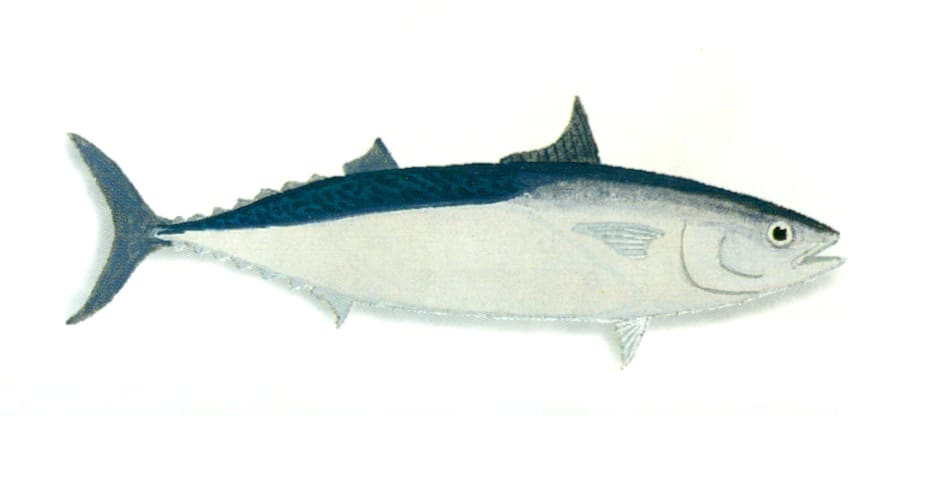
Taxonomy
- Kingdom
- Animalia
- Phylum
- Chordata
- Class
- Actinopterygii
- Order
- Perciformes
- Family
- Scombridae
- Genus
- Auxis
- Species
- thazard
Habitat
Frigate mackerel inhabit open ocean waters in the epipelagic zone, preferring warm tropical and subtropical seas. They are commonly found near the surface in areas with temperatures above 18°C and are associated with currents and upwellings that bring nutrient-rich waters. This species avoids coastal areas, staying in the pelagic environment across the Atlantic, Indian, and Pacific Oceans.
Diet
Frigate mackerel primarily feed on small fish such as anchovies and sardines, as well as squid and crustaceans. They exhibit schooling behavior while hunting, often chasing prey in groups during the day. Feeding activity peaks at dawn and dusk when visibility is moderate.
Behavior
Frigate mackerel are highly schooling fish, forming large groups that provide protection and enhance feeding efficiency. They are fast swimmers, capable of speeds up to 50 km/h, and migrate seasonally to follow warmer waters and food sources. These fish are diurnal, most active during the day, and show little territorial behavior in the open ocean.
Fishing
Frigate mackerel offer exciting recreational fishing opportunities in warm tropical and subtropical oceans, supporting conservation through angler license fees that fund habitat restoration and protect pelagic ecosystems. Use trolling with small lures like spoons or jigs that mimic baitfish, or live bait such as sardines and squid, for effective results; pair this with light to medium tackle, including a 7-foot spinning rod, 10-20 lb monofilament line, and a fast-retrieve reel to handle their high speeds up to 50 km/h. The best seasons are year-round in equatorial regions, with peak activity at dawn and dusk when they school and feed aggressively near the surface in open ocean waters associated with currents and upwellings, targeting areas with temperatures above 18°C while avoiding coastal zones. They typically reach lengths of 30-65 cm, with record sizes up to 70 cm and weights to 3 lbs 8 oz, and the IGFA all-tackle world record stands at 11 pounds 8 ounces, caught in 1994. Conservation-wise, as a Least Concern species with stable populations, anglers can contribute by following catch-and-release practices and adhering to regional regulations, such as size limits in some Atlantic and Pacific fisheries, which are effective tools for maintaining healthy stocks and ensuring sustainable fishing traditions.
Conservation Status
Listed as Least Concern by IUCN.