
Overview
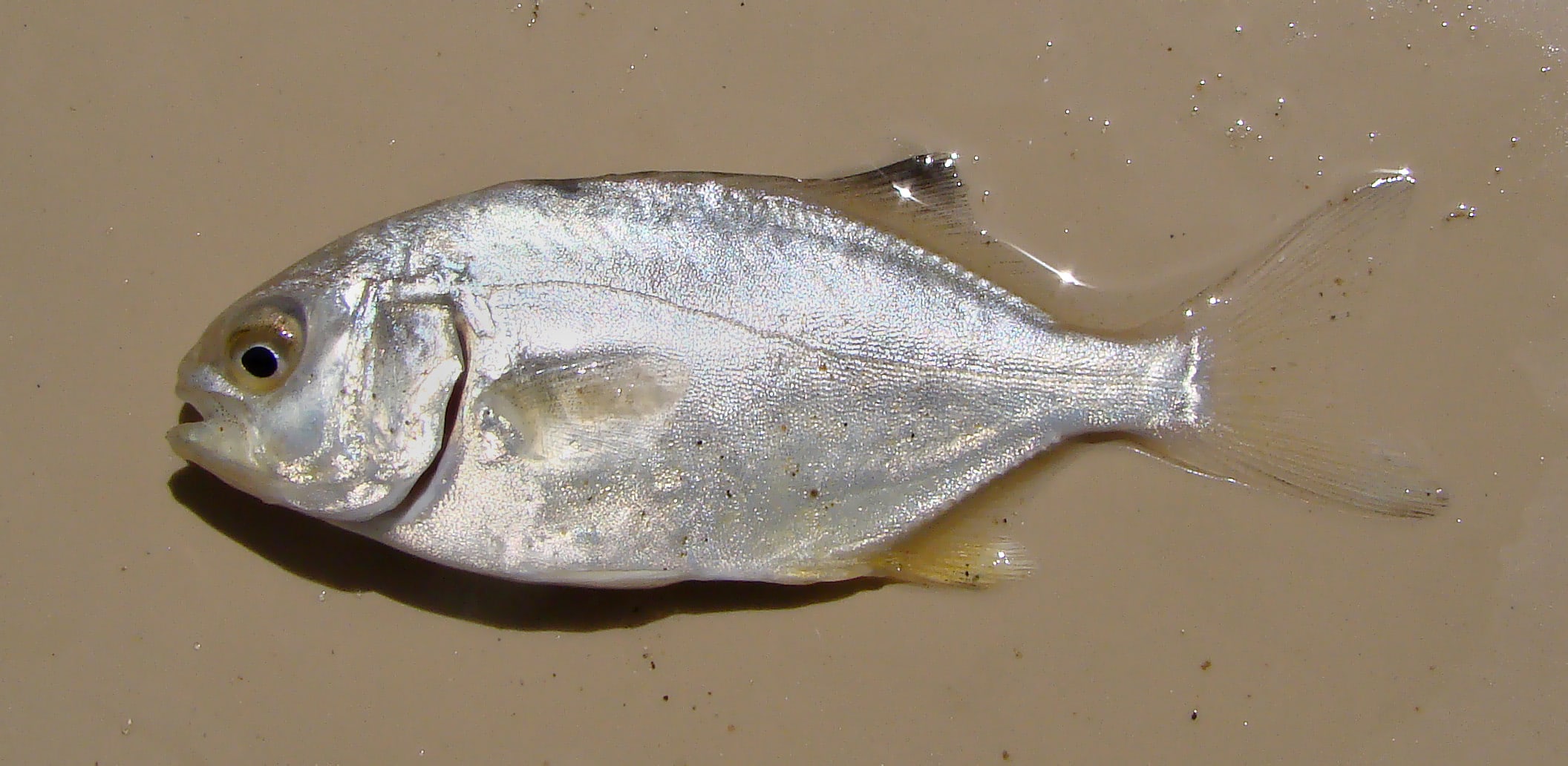
The body profile is relatively short, deep, and moderately compressed. Color is typically blue to greenish dorsally, fading to silver laterally, with the ventral surface tending to be silvery to yellow in color. There are no visible vertical bars on sides. Fins are dusky or yellowish in color, particularly the anal fin, which can be lemon yellow in young specimens (Gilbert 1986). The pectoral fins are shorter than the head, with the pelvic fins even shorter than the pectorals. The spinous portion of the dorsal fin has 6 spines that are set close to the body. The anterior portion of the second dorsal fin is elongated, with 22 – 27 (usually 23 – 25) soft rays that extend nearly to the caudal peduncle. The anal fin mirrors the dorsal fin, but has 20 – 24 (usually 21 – 22) rays and originates somewhat behind the dorsal fin. The caudal peduncle is moderately deep and lacks scutes and finlets. The caudal fin is deeply forked. The head profile slopes to a blunt snout, with the mouth somewhat inferior. Teeth are small and conical in young fish, but disappear by the time young grow to approximately 20 cm (7.9 inches). There are no teeth on the tongue at any life stage. There are 8 – 14 gill rakers on the lower limb of the gill arch. Well developed pharyngeal plates are present. Scales are small and cycloid. The lateral line arches to the midpoint of the soft dorsal fin and then becomes straight toward the caudal fin (Berry and Smith-Vaniz, 1978; Gilbert 1986).
Taxonomy
- Kingdom
- Animalia
- Phylum
- Chordata
- Class
- Actinopterygii
- Order
- Cichliformes
- Family
- Carangidae
- Genus
- Trachinotus
- Species
- carolinus
Habitat
They can be found in the surf zone, major bays with sandy bottoms, and in coastal waters. Their local movements are tidally influenced and their seasonal movements are influenced by water temperature.
Diet
They are schooling, bottom feeders and their main diet consists of mollusks, crustaceans, other small invertebrates and fish.
Behavior
Florida pompano are highly schooling fish that form large groups to forage and migrate, making them more active during daylight hours in warmer waters. They exhibit rapid swimming and evasion tactics to avoid predators, and their movements are influenced by tides and currents, often seen darting in surf zones. They are not particularly territorial but maintain cohesive school structures for protection and feeding efficiency.
Fishing
Pompano are sought after for their white, flaky meat and are one of the highest priced marine foods in the USA. Unlike permit that are common to 40 pounds, pompano rarely grow larger than 6 pounds but, like most members of the jack family, are an excellent fighting fish for their size.
Conservation Status
Listed as Least Concern by IUCN.