
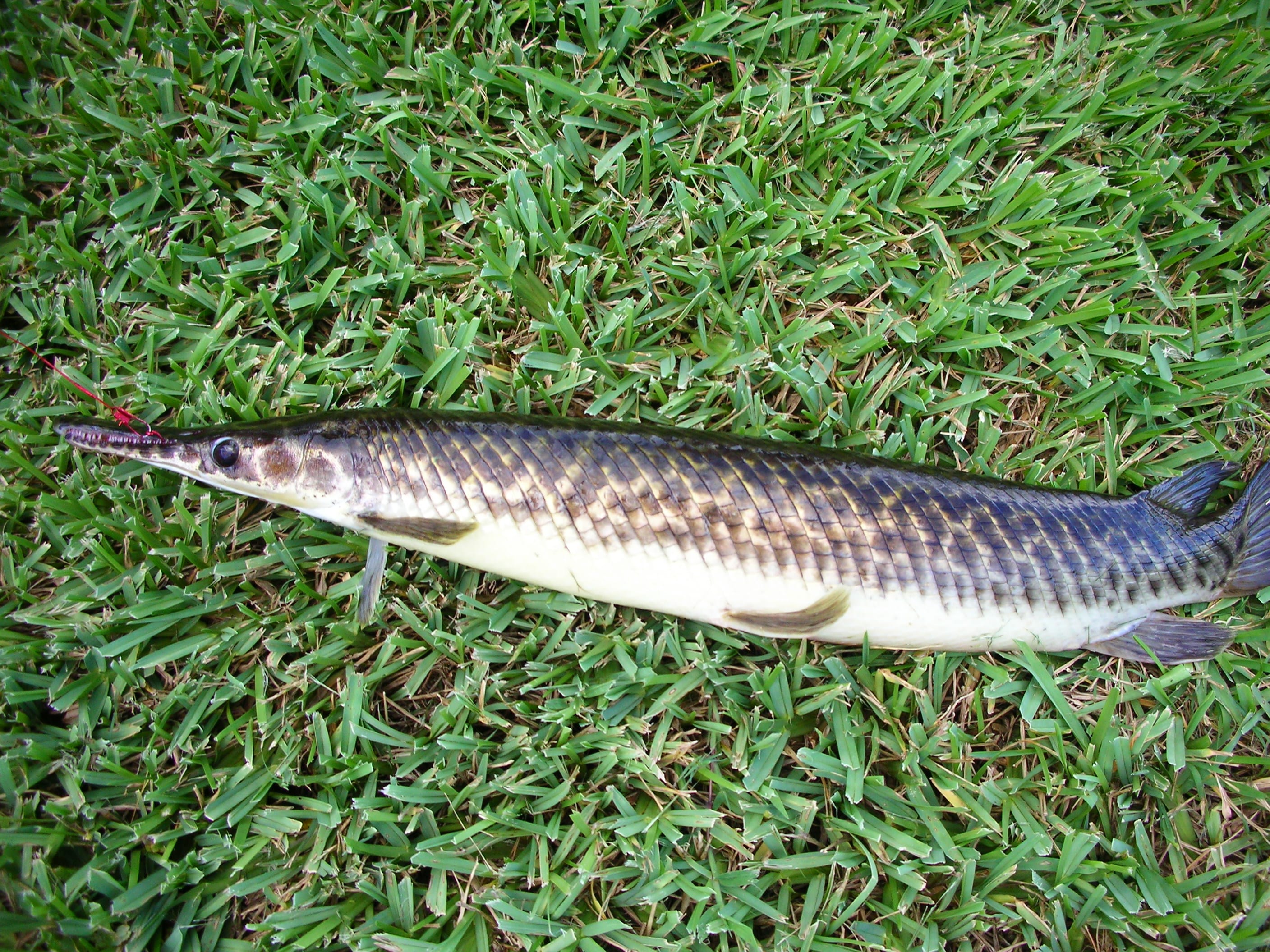
Overview
Like the spotted gar, it has spots on top of the head as well as over the entire body and on all the fins. Other gars have spots on the fins and usually on the posterior part of the body only. The Florida and spotted gars can be distinguished from each other mainly by the distance from the front of the eye to the back of the gill cover. In the Florida gar the distance is less than 2/3 the length of the snout, and in the spotted gar it is more than 2/3 the length. The only other gar that is known to occur within the Florida gar's range is the longnose gar (L. osseus) which is found throughout much of the eastern half of the U.S.A., including Florida, at least as far south as Lake Okeechobee. The longnose gar, however, lacks spots on top of its head and its beak is 18 20 times as long as it is wide (at its narrowest point), while the Florida gar's beak is probably less than 5 ½ times as long as it is wide.
Taxonomy
- Kingdom
- Animalia
- Phylum
- Chordata
- Class
- Actinopterygii
- Order
- Perciformes
- Family
- Lepisosteidae
- Genus
- Lepisosteus
- Species
- platyrhincus
Habitat
The Florida gar is relatively common in medium to large lowland streams and lakes with mud or sand bottoms and an abundance of underwater vegetation. It is also abundant in canals, such as the Tmi.
Diet
Florida gars primarily feed on small fish, insects, crayfish, and occasionally amphibians or crustaceans. They are ambush predators that strike quickly from hiding spots in vegetation, often at dawn or dusk. Feeding behavior includes swallowing prey whole after a rapid lunge.
Behavior
Florida gars are solitary and territorial, often lurking in dense vegetation or near structures in slow-moving waters. They are primarily nocturnal hunters but can be active during the day in low-light conditions, and they surface to gulp air in oxygen-poor environments. This adaptation allows them to survive in stagnant waters where other fish might not.
Fishing
Gars are popular as a sport fish. Although edible, they are unpopular as food. The roe is highly toxic to humans, animals, and birds.
Conservation Status
Listed as Least Concern by IUCN.