
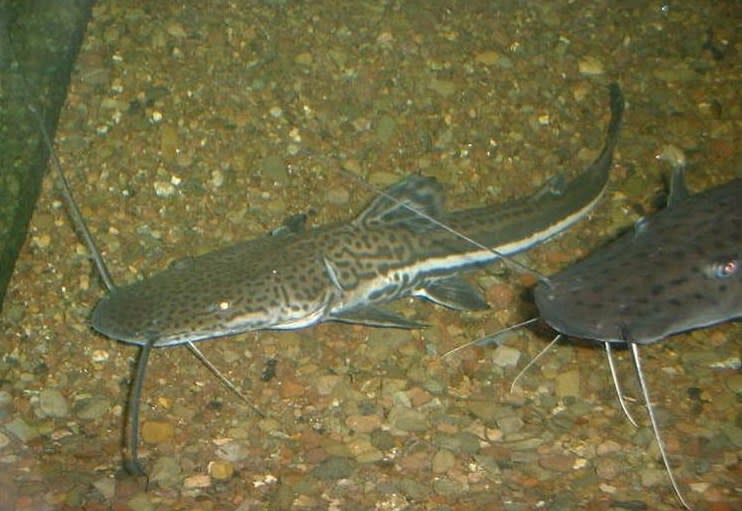
Taxonomy
- Kingdom
- Animalia
- Phylum
- Chordata
- Class
- Actinopterygii
- Order
- Perciformes
- Family
- Pimelodidae
- Genus
- Sorubimichthys
- Species
- planiceps
Habitat
This species inhabits large river systems in South America, including the Amazon and Orinoco basins, preferring deep, flowing waters with sandy or muddy substrates. It thrives in areas with moderate currents and abundant cover like submerged logs or vegetation. These environments provide both hunting grounds and protection from predators.
Diet
The Firewood catfish is primarily carnivorous, feeding on smaller fish, crustaceans, and insects. It hunts nocturnally, using its sensitive barbels to detect prey in low-visibility waters. Feeding occurs mainly at night when it ambushes prey in river channels.
Behavior
Firewood catfish are solitary and nocturnal, spending daylight hours hidden in crevices or under cover. They exhibit territorial behavior around feeding sites, aggressively defending against intruders. During migration for spawning, they may travel long distances in river systems.
Fishing
Anglers targeting the Firewood catfish, a prized species in South America's Amazon and Orinoco river systems, should focus on nocturnal bottom fishing or trolling techniques using live bait to capitalize on its carnivorous, ambush-hunting behavior. Employ heavy-action rods (7-9 feet) with strong monofilament or braided lines of 20-50 lb test, paired with sturdy reels featuring a high drag capacity, and size 5/0 to 8/0 circle hooks to minimize injury during catch-and-release. Effective baits and lures include live minnows, shrimp, or crankbaits that mimic small fish and crustaceans, presented near the bottom in areas with moderate currents. The best season is during the rainy months from November to March, when fish are more active and migratory, with prime fishing times at night or dawn in low-light conditions for higher success rates. Target deep, flowing river channels with sandy or muddy substrates and abundant cover like submerged logs or vegetation, such as in the Guaviare, Putumayo, or Caqueta rivers, where these fish thrive. Record sizes include specimens up to 150 cm in length and 35 lbs 4 oz, adding to the excitement of this sport fish. As a not evaluated species by the IUCN, anglers play a key role in conservation by adhering to catch-and-release practices and supporting license-funded programs that protect these river ecosystems and promote sustainable populations.
Conservation Status
Listed as Not Evaluated by IUCN.