
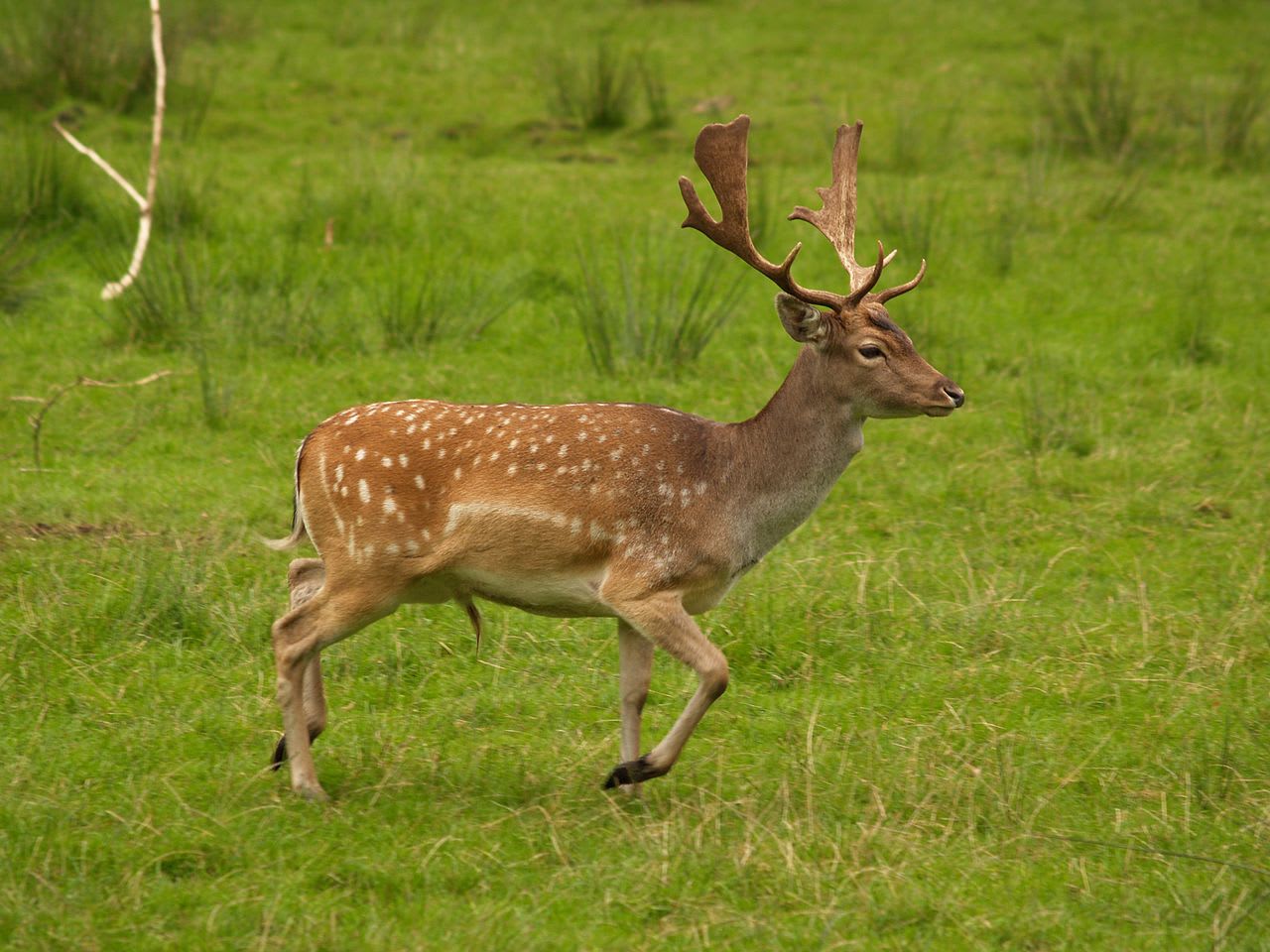
Taxonomy
- Kingdom
- Animalia
- Phylum
- Chordata
- Class
- Mammal
- Order
- Artiodactyla
- Family
- Cervidae
- Genus
- Dama
Habitat
Fallow deer primarily inhabit deciduous and mixed woodlands, open forests, and grasslands with access to cover. They are native to the Mediterranean region but have been introduced to parts of Europe, North America, and elsewhere, often thriving in agricultural areas and parks.
Diet
Fallow deer are herbivores that feed on grasses, leaves, shoots, and fruits, with a preference for browsing on trees and shrubs in forested areas. They graze in open meadows and adjust their diet seasonally, consuming more bark and twigs in winter, and are most active feeding at dawn and dusk.
Behavior
Fallow deer are social animals that form herds, particularly females and fawns, while males are often solitary or in bachelor groups outside the breeding season. They are crepuscular, most active at dawn and dusk, and males become territorial and vocal during the autumn rut to attract females. They communicate through grunts, bleats, and body postures, and are agile runners that use cover to evade threats.
Hunting
Fallow deer are a favored game species for hunters, typically pursued using spot-and-stalk methods in woodlands or driven hunts in open fields, with success relying on understanding their crepuscular behavior and using calls during the rut to draw them in. Opt for rifles in calibers like .243 Winchester, .270 Winchester, or .30-06 Springfield for their balance of accuracy and power, focusing on precise shot placement in the heart-lung area for an ethical harvest; a good rest or bipod enhances accuracy at typical ranges of 100-200 yards. The prime hunting season is autumn, from September to November, coinciding with the rut when bucks are more active and easier to spot. For trophies, target mature bucks with broad, palmate antlers exceeding 20 inches in span, as recognized by record books like Safari Club International (SCI) and Boone & Crockett Club, which celebrate outstanding specimens. Legal hunting is available in regions such as the United Kingdom, Italy, and various U.S. states like Texas on private ranches, where regulated harvests manage introduced populations to prevent overgrazing and habitat damage, funding conservation programs that echo the success of the North American Model, which has channeled hunting revenues into wildlife recovery and habitat protection worldwide.
Conservation Status
The IUCN classifies fallow deer as Least Concern due to their wide distribution and stable or increasing populations in many areas. Major threats include habitat fragmentation and overhunting in some regions.