
Overview
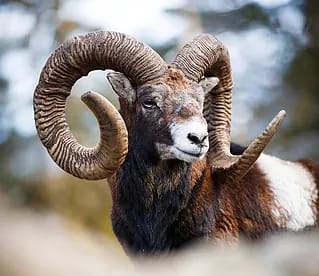
The urial is one of the smaller wild sheep species. This subspecies resembles a slim domestic sheep, except that it has a normal coat of hair with any wool being concealed beneath. It's upper parts are reddish-brown with a pale (almost white) saddle patch in the winter coat. Underparts, rump, lower legs, and muzzle are white. There is dark neck ruff but no bib. The horns usually grow in a tight circle, with the tips turned inward toward the face and broomed back to about a three-quarter curl. In a purebred European mouflon, the tip-to-tip spread should not be the widest spread. Females sometimes grow small horns, but are usually hornless.
Taxonomy
- Kingdom
- Animalia
- Phylum
- Chordata
- Class
- Mammal
- Order
- Artiodactyla
- Family
- Bovidae
- Genus
- Ovis
- Species
- Mouflon, gmelini
Habitat
This animal prefers steep, wooded mountains, but has adapted to woodlands and meadows where introduced on the European mainland.
Diet
Primarily grazes but will browse when necessary.
Behavior
Gregarious. Females with young form year-round flocks; mature males remain separate from the females except during the mating season, which lasts from October to November. Lambs (usually one, sometimes twins) are born five months later. Females are sexually mature at less than one year old. Vision and hearing are excellent, while their sense of smell is not as good.
Hunting
The purebred mouflon, especially an old male with large horns, is a fine game animal that is difficult to hunt. Alert and wary where hunted, and has good learning ability. It is the one of the only sheep that is mainly nocturnal and lives in thick cover. The premier hunting period is during the October-November rut, at roughly the same time as fallow deer, which makes for a good combination. Good heads can be found throughout Europe but traditionally the best trophies have come from the Czech Republic, with Spain also producing some very good heads.
Conservation Status
Mouflons from Corsica and Sardinia, formerly considered endangered by the IUCN, have been upgraded to vulnerable.