
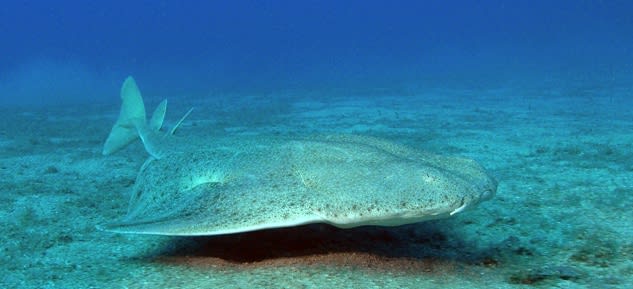
Taxonomy
- Kingdom
- Animalia
- Phylum
- Chordata
- Class
- Chondrichthyes
- Order
- Squaliformes
- Family
- Squatinidae
- Genus
- Squatina
- Species
- squatina
Habitat
This species inhabits sandy or muddy seabeds on the continental shelf, typically at depths of 5 to 400 meters in the northeast Atlantic Ocean, including areas around Ireland, Scandinavia, and the Mediterranean Sea. It prefers coastal waters and estuaries but can also be found in deeper offshore environments. These habitats provide ample cover for ambush hunting.
Diet
The European angel shark primarily feeds on bottom-dwelling fish such as flatfish and gobies, as well as squid, crustaceans like crabs, and occasionally mollusks. It employs an ambush strategy, lying buried in the sediment and striking quickly at prey that ventures nearby, often feeding at night when it is most active. This feeding behavior helps it conserve energy in its benthic environment.
Behavior
The European angel shark is primarily nocturnal, spending the day buried in sand or mud to avoid detection and emerging at night to hunt. It is a solitary species with minimal social interactions, showing territorial behavior by remaining in specific areas for extended periods. This ambush predator relies on stealth and surprise rather than speed, making it highly adapted to its seafloor habitat.
Conservation Status
Listed as Critically Endangered by IUCN.