
Overview
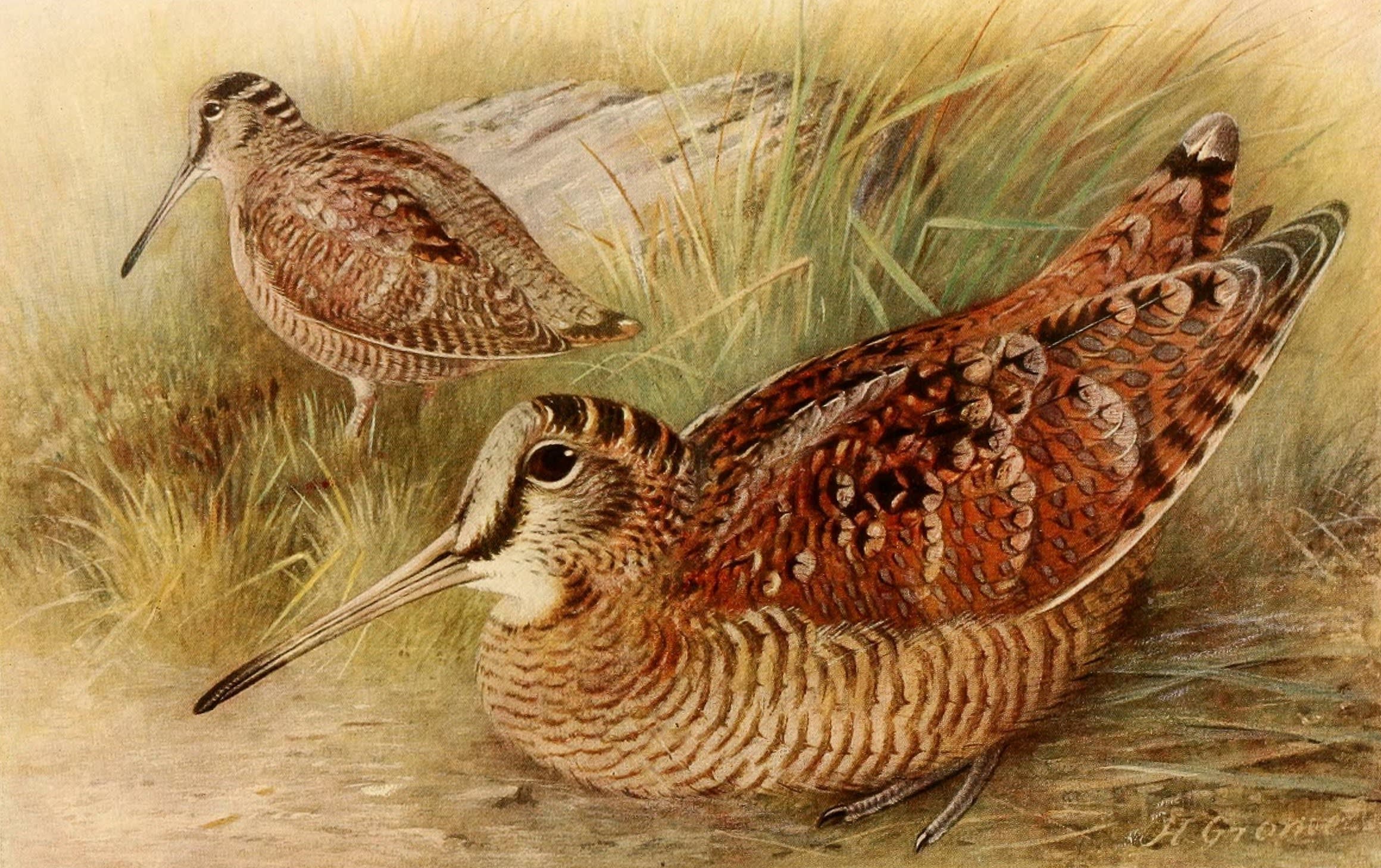
The Eurasian woodcock has cryptic camouflage to suit its woodland habitat, with intricately patterned reddish-brown upperparts and buff underparts. The head is barred with black, not striped like that of its close relatives, the snipe. It has large eyes located high on the sides of its head, giving it 360-degree monocular vision. The wings are rounded and the base of the bill is flesh-coloured with a dark tip. The legs vary from grey to pinkish. The species is sexually dimorphic, with the male much larger than the female, although the sexes cannot be separated in the field.
Taxonomy
- Kingdom
- Animalia
- Phylum
- Chordata
- Class
- Bird
- Family
- Scolopacidae
- Genus
- Scolopax
- Species
- rusticola
Habitat
Broadleaved deciduous or mixed broadleaved and coniferous forest, with dense undergrowth of plants such as brambles, holly, hazel, gorse, bracken or bilberry.
Diet
They mainly eat earthworms, but also insects and their larvae, freshwater molluscs and some plant seeds.
Behavior
Eurasian woodcock are crepuscular (most active at dawn and dusk) and rarely active during the day unless flushed, when they fly off with a whirring wing noise. The flight is somewhat owl- or bat-like; woodcock fly fast and directly while migrating or crossing open country, but fly erratically with twisting and fluttering once in woodland. They are usually solitary and migrate singly, but may congregate when weather or geographical conditions force them to do so. This species is parasitised by the moorhen flea, Dasypsyllus gallinulae.
Hunting
In many countries woodcock are hunted as game, and their size, speed and flight pattern makes them a very challenging shot. Anyone shooting a witnessed 'right and left'—in which two woodcock are killed with consecutive shots from a shotgun, without the gun being lowered or reloaded—can be admitted to the Shooting Times Woodcock Club.
Conservation Status
Listed as Least Concern by IUCN.