
Overview
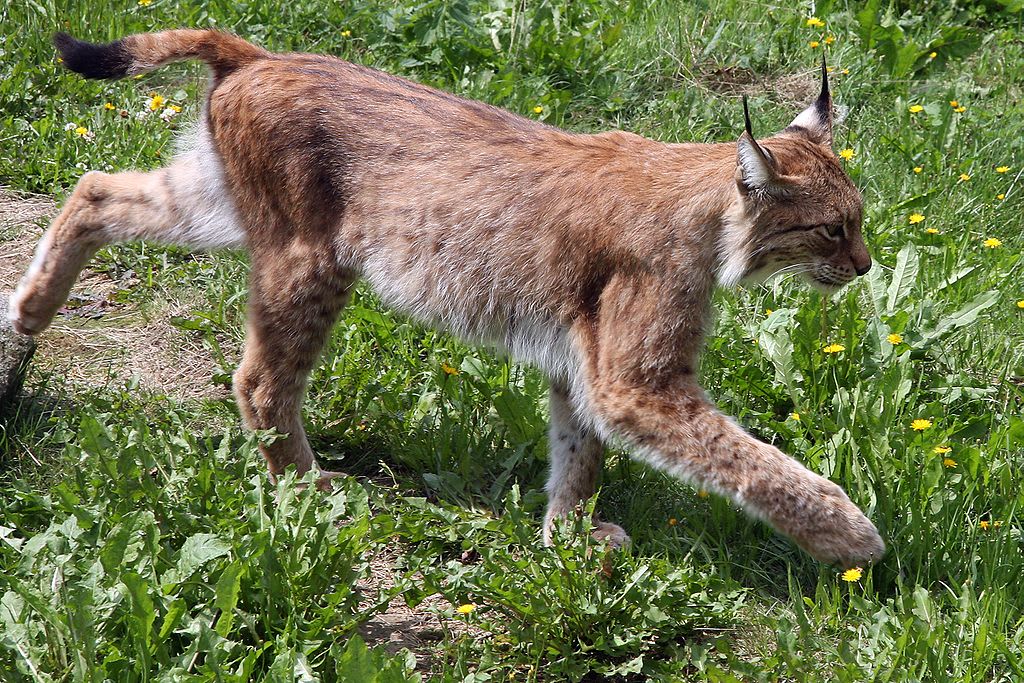
The Eurasian lynx is the largest of the world's lynxes. It is a distinctive, medium-sized cat with prominent black ear tufts, pronounced cheek ruffs, relatively long legs, very large feet, and a short tail with a black tip. The coat is reddish-gray to yellowish-gray, and may be predominantely spotted, predominantely striped, or unpatterned. The winter coat is long, soft and thick, and the paws are densely furred for walking in snow.
Taxonomy
- Kingdom
- Animalia
- Phylum
- Chordata
- Class
- Mammal
- Order
- Carnivora
- Family
- Felidae
- Genus
- Lynx
Habitat
Wooded areas, preferably high forests with dense undergrowth, often in steep, mountainous terrain. Distribution- Eurasian lynxes are found in the taiga forest zone from Scandinavia to eastern Siberia, and in the mountain forests of Europe, the Middle East and Asia. In Europe, they occur mainly in Scandinavia and Russia, and in the Carpathian Mountains along the Czech-Polish border and extending through Romania. Isolated populations also occur in northeastern Poland, the Balkan countries, and possibly southern France. Recently reintroduced in parts of Germany, Austria, Switzerland, Italy and the former Yugoslavia.
Diet
Hunts mainly by sight, preying on small hoofed mammals such as roe deer, chamois, and fawns of larger deer species. Will generally take small animals such as rabbits only when larger prey is unavailable.
Behavior
Solitary, except when breeding or when females are with their young. Territorial. Mating season is March-April. The female delivers one litter a year, usually with 2-3 kittens (range is 1-5) that remain with her until the following winter. A shy animal that is seldom seen by humans. Active mainly during evening and morning. A poor, quickly winded runner, but a tireless walker and good tree climber. Good swimmer, able to cross large rivers. Eyesight and hearing are good, sense of smell is adequate.
Hunting
Lynxes may be hunted in several eastern European countries. Usually taken as a target of opportunity while stalking another animal, or during a drive for wild boar.
Conservation Status
Listed as Least Concern by IUCN.