
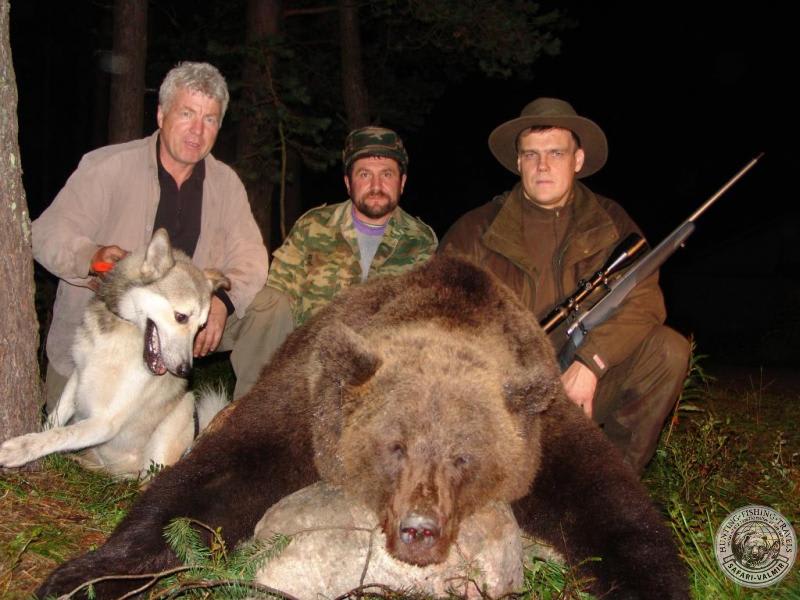
Overview
A good-sized, powerfully built bear with a distinct shoulder hump, a large head supported by a short, muscular neck, and a concave facial profile. Overall color can vary with individual bears from light grayish-yellow to very dark brown. Juveniles may have a conspicuous pale collar. The coat is long or not, depending on region and season.
Taxonomy
- Kingdom
- Animalia
- Phylum
- Chordata
- Class
- Mammal
- Family
- Ursidae
- Genus
- Ursus
- Species
- Ursus arctos
Habitat
Coniferous forests with an understory of food plants, especially with steep terrain and difficult access, at any altitude. Distribution- Formerly all forested parts of Europe, but now extinct in the British Isles and much of western Europe. Mainly found today in Russia, Romania and the former Yugoslavia, but brown bears also occur in Norway, Sweden, Finland, the Czech Republic, Slovakia, Poland, Hungary, Albania, Bulgaria and Greece, and remnant populations are found in Spain, France and Italy. Outside Europe, the Eurasian brown bear is also found in northwestern Asia.
Diet
Largely herbivorous, eating all kinds of plant material. Also eats ants, insect larvae, honey, rodents, fish and carrion. Sometimes takes larger animals such as moose, reindeer, and domestic livestock.
Behavior
Solitary except when mating, or a female with her cubs. Territorial, with a large home range. Breeds late May to July, with cubs (usually twins, range 1-3) born in the den from late December to February. Cubs remain with the mother two years or longer. Sexually mature at five years or later. Maximum longevity in captivity has been 47 years. Active mainly at twilight and at night. Dens up in autumn, usually in a cave or rock crevice, and hibernates 5-6 months in the north (October-November to April), or 3-4 months (December-January to March) farther south. Senses of smell and hearing are excellent, eyesight not as good. A fast runner, able to gallop for miles, and surprisingly agile. An excellent swimmer. Adults are unable to climb trees because of the shape of their claws and their body weight.
Hunting
The largest specimens are in eastern parts of Europe. Hunted by baiting during the spring, by chance encounter while hunting other game during the fall, or by drives in some eastern European countries. In Russia, bears are sometimes hunted by breaking into their dens during hibernation.
Conservation Status
The species as a whole is listed as Least Concern by IUCN, but this subspecies has faced serious threats to its existence in the recent past. No longer in danger of extinction in Europe, but its range is shrinking from loss of habitat. Protected totally or seasonally in most countries. Has shown itself able to coexist with man without serious conflicts. The Italian population was listed as endangered by the USF&WS (1976).