
Overview
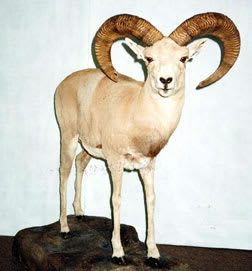
Saddle patch, muzzle, chin, throat and lower part of legs are white. There is no bib. In the winter, males have a full-length black neck ruff extending to the brisket.The horns appear to be of two types. Those from the Mooteh Wildlife Reserve, about 80 miles (130 km) northeast of Esfahan, which are supracervical, or perverted, which is to say they curve above and behind the neck as do the Armenian mouflon subspecies. Then there are the horns found in the Tange-Sayad and Kolah-Gazi wildlife refuges, which are within 90 miles (145 km) southwest and southeast, respectively, of Esfahan. The horns are cervical, with the tips growing inward toward the neck. The frontal-orbital horn edge is rounded, the frontal-nuchal edge is sharp. Females are similar in appearance to Armenian mouflon females. Some have very small horns, but most appear to be hornless. This sheep has many characteristics of the Armenian mouflon, but has had enough influence over time from the Laristan mouflon and Shiraz mouflon to be distinctly different from the Armenian mouflon. Horns sweep down more than the Armenian, and the coloration is slightly different as well.
Taxonomy
- Kingdom
- Animalia
- Phylum
- Chordata
- Class
- Mammal
- Order
- Artiodactyla
- Family
- Bovidae
- Genus
- Ovis
- Species
- Mouflon, gmelini
Habitat
They prefer the more arid mountain grasslands that contain juniper and almond scrub bush, as well as subalpine and alpine meadows. Tend to inhabit open spaces with alternating rocky outcrops and canyons at 1000-3000 meters above sea level.
Diet
Primarily a grazer, but will browse when necessary.
Behavior
A gregarious animal and the herds they form are non-territorial. They can be found resting during the day under and between rocks and shade trees where they can stay well hidden. Mating season lasts from late November to early December with females giving usually giving birth to one single lamb after a 5-6 month gestation.
Hunting
The hunting season usually runs from the first of October to the end of February. Good physical condition is required. A typical hunt includes glassing canyons and ridges for sheep and then executing a stalk. Horses may be available in some camps. The climate is wet and humid in the North of Iran close approaching the Caspian Sea, while the weather is warmer and dry to the south. Hunters should be prepared with good windbreakers and layered underclothing in case they are pinned down and must spend hours waiting on the animal.
Conservation Status
This subspecies is susceptable to many threats due to their limited range. Further protection and research is necessary to ensure the continued survival of this animal.