
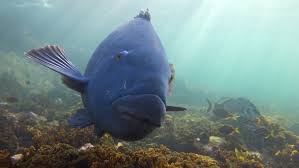
Taxonomy
- Kingdom
- Animalia
- Phylum
- Chordata
- Class
- Actinopterygii
- Order
- Perciformes
- Family
- Labridae
- Genus
- Achoerodus
- Species
- viridis
Habitat
This species inhabits rocky reefs, kelp forests, and coastal waters with abundant crevices for shelter. It is primarily found along the southeastern coast of Australia, from southern Queensland to Tasmania, preferring temperate waters with moderate wave action. These areas provide both food sources and protection from predators.
Diet
Eastern blue gropers primarily feed on crustaceans, mollusks, and small fish, using their strong jaws to crush hard shells. They forage actively during the day on reefs and among rocks, employing a sit-and-wait strategy to ambush prey. Feeding behavior includes turning over rocks and probing crevices for hidden invertebrates.
Behavior
Eastern blue gropers are generally solitary or found in small groups, with males being highly territorial and defending their areas aggressively. They are diurnal, active during the day for feeding and exploring, and exhibit protogynous hermaphroditism where females can change to males. Notable behaviors include curiosity towards divers and a slow, deliberate swimming style near the substrate.
Fishing
The Eastern blue groper is a popular sport fish along southeastern Australia's rocky reefs, known for its strong fights and curiosity, making it a favorite for recreational anglers who contribute to conservation through license fees and habitat programs. Best techniques include bottom fishing with bait or light jigging to draw them from crevices, focusing on a steady retrieve to mimic prey. Use medium-heavy rods with 20-30 lb test line, sturdy reels for handling runs, and hooks sized 2/0 to 4/0 for secure holds. Effective baits and lures are fresh crabs, prawns, or soft plastics imitating crustaceans and small fish, as these match their diet of shellfish and invertebrates. The best season is summer during spawning, with optimal times in the early morning or late afternoon when they are most active; target them in rocky reefs, kelp forests, and coastal waters with moderate wave action from southern Queensland to Tasmania. Record sizes reach up to 1.2 meters and 4 lbs 4 oz, though specific IGFA records are not available. As a Near Threatened species, conservation efforts are supported by angler-funded programs, and regulations such as catch-and-release requirements and protected areas in regions like New South Wales serve as effective management tools to sustain populations and promote healthy waterways for future fishing opportunities.
Conservation Status
Listed as Near Threatened by IUCN.