
Overview
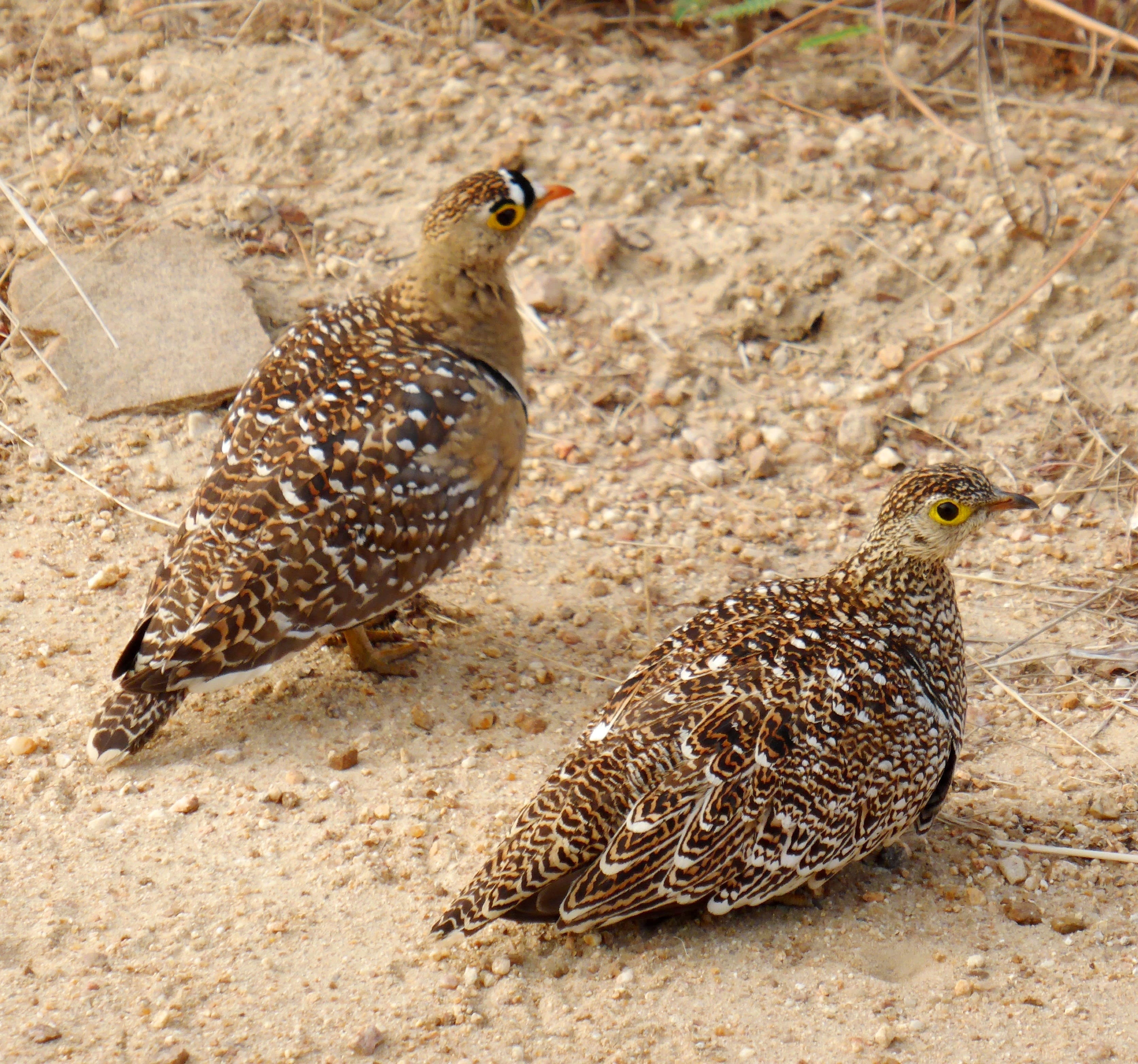
A moderate sized bird with a plump body, the double-banded sandgrouse has a small pigeon-like head and long wings and tail. The general colour of the plumage is light brown with darker mottling and rows of whitish specks. The male is distinguished by having a conspicuous black and white band on its forehead and a chestnut throat area delineated by another black and white band. Both sexes have an area of bare yellow skin surrounding their eye and the male has an orange beak. The female is smaller and duller in colour. The juvenile resembles the female.
Taxonomy
- Kingdom
- Animalia
- Phylum
- Chordata
- Class
- Bird
- Family
- Pteroclididae
- Genus
- Pterocles
- Species
- bicinctus
Habitat
It is found in arid parts of southern Africa.
Diet
The diet consists largely of seeds including acacia, red pea (Requenia sphaerosperma), Tephrosia, Cyperus, blackjack (Bidens bidentata) and hairy thorn-apple Datura innoxia.
Behavior
Breeding takes place between February and September, peaking earlier in the northern part of the range than the south. The male has a courtship display in which he walks round in circles with his beak near the ground and his tail raised high. The nest is a shallow depression in the soil, lined with a few bits of dried vegetation, often hidden between grass tufts or under a bush. Two or three eggs are laid and both sexes take it in turn to incubate them. They hatch in about 24 days. The chicks are precocial, being active with eyes open and clothed in fluffy down as soon as they are hatched. In about a month they have grown adult-type feathers and can fly. The double-banded sandgrouse is most often seen in groups of one to five birds, often two or four. The birds are monogamous and these are probably pairs or family units. In the morning they tend to feed in dry areas well away from water but in the afternoon they are most often seen near watering places. They visit water again, often in larger groups of up to 10, after dark.
Hunting
Hunted across its range.
Conservation Status
Listed as Least Concern by IUCN.