
Overview
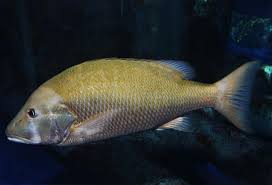
The name comes, of course, from the canine teeth, which seem even more prominent than in most other large Snappers. Overall coloration is light orange or yellowish, darker on the back and lighter on the sides. The tail and dorsal fin are deep yellow or orange, while the other fins are lighter yellow. There is a broken blue streak on gill cover below the eye and a white, V-shaped patch on the gill cover, under the blue markings.
Taxonomy
- Kingdom
- Animalia
- Phylum
- Chordata
- Class
- Actinopterygii
- Order
- Perciformes
- Family
- Lutjanidae
- Genus
- Lutjanus
- Species
- jocu
Habitat
Dog snappers primarily inhabit coral reefs, rocky bottoms, and occasionally mangrove areas in tropical and subtropical waters. They prefer depths ranging from 10 to 200 meters in the western Atlantic Ocean, often seeking shelter in crevices or near structures. These environments provide ample cover and food sources.
Diet
Dog snappers feed mainly on fish, crustaceans such as crabs and shrimp, and cephalopods like squid. They are active predators that hunt during the day, using ambush tactics in reef environments. Feeding occurs primarily in open water near structures.
Behavior
Dog snappers are typically solitary or found in small groups, exhibiting territorial behavior around coral reefs and rocky areas. They are diurnal, active during the day for hunting and resting at night in crevices. These fish can be cautious and elusive when approached by divers or anglers.
Fishing
Target dog snappers, a prized sport fish in the western Atlantic from the Bahamas to Brazil, using effective techniques like bottom fishing with live bait or trolling near structures, as these ambush predators are most active around coral reefs and rocky bottoms in depths of 10 to 200 meters—focus on areas with crevices for the best results. Use medium-heavy tackle, including a 7- to 9-foot rod with a strong reel spooled with 20- to 50-pound monofilament or braided line, paired with a sturdy leader to handle their toothy mouths and powerful runs; for bait and lures, opt for live shrimp, crabs, or small fish, or try metal jigs and diving plugs to mimic their natural prey like crustaceans and fish. The best season is during warmer months from spring to summer when they spawn, with peak activity in the daytime, especially around dawn and dusk for higher success rates. Anglers should target these fish in tropical and subtropical waters of the Atlantic, such as around the Bahamas or Belize, where habitat protection through angler-funded programs helps maintain healthy populations. The IGFA all-tackle world record stands at 24 pounds 0 ounces, caught in 1990, underscoring the thrill of the sport. Conservation-wise, while dog snappers are listed as Data Deficient by the IUCN, slot limits and catch-and-release practices in many areas serve as effective management tools to ensure sustainable populations, supported by license fees that fund habitat restoration and protect these vital reef ecosystems.
Conservation Status
Listed as Data Deficient by IUCN.