
Overview
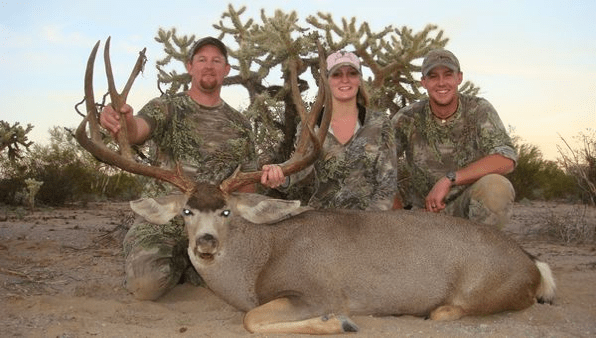
The desert mule deer is similar to the Rocky Mountain mule deer, although slightly smaller, paler in color and with a smaller rump patch. The typical desert mule deer (crooki race) has a comparatively small forehead patch and a dark line running partway down its tail. The southern mule deer (fuliginatus race) is dark-colored with a dark line down its back and almost no white on the tail. The peninsula mule deer (peninsulae race) is pale with a dark line down its back and more white on its tail than the southern mule deer. In all desert mule deer, the antlers are not as heavy or as high as in Rocky Mountain mule deer. Desert mule deer racks tend to have wide spreads, and many lack brow tines.
Taxonomy
- Kingdom
- Animalia
- Phylum
- Chordata
- Class
- Mammal
- Order
- Artiodactyla
- Family
- Cervidae
- Genus
- Odocoileus
- Species
- Odocoileus hemionus
Habitat
Desert and semi-arid regions. Distribution- California: The extreme south, in Riverside, Imperial, Orange and San Diego counties. Arizona: South of Highway 68 from Davis Dam on Lake Mohave eastward to Kingman on Interstate 40, then south of Interstate 40 between Kingman and the intersection with Hwy 93, then southwest of Hwy 93 southward between Kingman and Wickenburg, then south of latitude 34°N eastward between Wickenburg and Carrizo on Hwy 60, then west of Hwy 60 southward between between Carrizo and Globe on Hwy 70, then south of Hwy 70 between Globe and Safford, then south of Hwys 191 and 78 from Safford to the New Mexico border. New Mexico: South of Highway 78 from the Arizona border eastward to Hwy 180, then southwest of Hwy 180 through Silver City to the intersection with Hwy 152, then south of Hwy 152 to Caballo on Interstate 25, then east of Interstate 25 northward to Bernardo on Hwy 60, then south of Hwy 60 eastward to Fort Sumner on Hwy 84, then south of Hwy 60/84 to the Texas border. Texas: Most desert mule deer are found in the trans-Pecos region west of the Pecos River, but they also occur in a number of places in the Panhandle region. The game department considers all mule deer in Texas to be desert mule deer, either native populations or from 1949-1968 transplants from the trans-Pecos desert mule deer herd. We accept this in the absence of conflicting opinion. Mexico: Northern Sonora, northern Chihuahua, northwestern Coahuila, Durango, Nuevo Leon, Tamaulipas, San Luis Potosi, Zacatecas.
Diet
Eats a wide variety of desert plants, from grasses and shrubs, to cacti and succulents, along with other plants based on seasonal availability.
Behavior
Has adapted successfully to extremely harsh conditions-great heat and also intense cold, meager forage, scarce water, and lack of vegetative cover. Mule deer appear to hop instead of run compared to their white-tailed counterparts. They will often remain motionless in thick cover to avoid predators, and they will do this more than whitetails. Males will usually be found together in bachelor herds during most of the year except the breeding season.
Hunting
The type of hunt greatly depends on the landscape you are hunting, and desert mule deer can be found in both mountainous regions, grass plains, and mixed agricultural land. Hunted with a variety of methods, though spot-and-stalk tends to prevail in the open and arid regions these deer inhabit. Good glass is a must, and windy conditions can actually be an advantage when stalking a located bedded animal. This is in contrast with whitetail hunting when you are more dependant on the animal being up and active to be succesful.
Conservation Status
Listed as Least Concern by IUCN.