
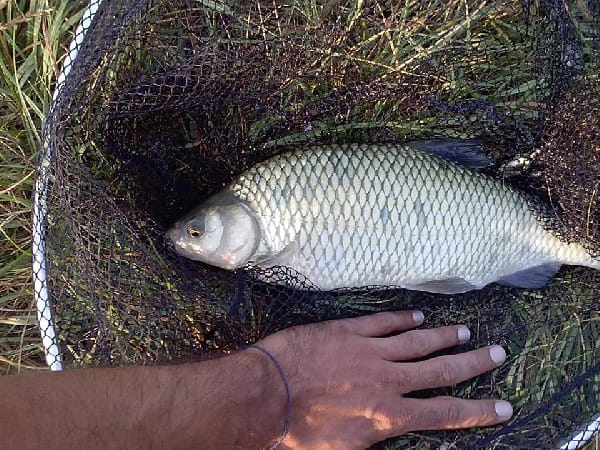
Taxonomy
- Kingdom
- Animalia
- Phylum
- Chordata
- Class
- Actinopterygii
- Order
- Osteoglossiformes
- Family
- Cyprinidae
- Genus
- Rutilus
- Species
- pigus
Habitat
Danube roach primarily inhabit large rivers and connected lakes in Europe, favoring clear, flowing waters with gravel or sandy substrates. They are commonly found in the Danube basin, including areas in Germany, France, Italy, and Switzerland, as well as in the Adriatic basin's rivers and lakes like Maggiore and Lugano. These fish prefer moderate currents and depths up to several meters.
Diet
Danube roach are omnivorous, feeding on aquatic insects, crustaceans, small mollusks, and plant material such as algae and detritus. They forage mainly on the bottom during dawn and dusk, using their sensitive mouths to detect and consume food in riverbeds and lake shallows. Feeding behavior includes occasional surface feeding on drifting insects.
Behavior
Danube roach are schooling fish that form groups for protection and foraging, often active during the day in open water. They exhibit territorial behavior during spawning seasons, migrating upstream to gravel beds. Notable behaviors include rapid swimming to evade predators and seasonal movements in response to water temperature changes.
Fishing
Target the Danube roach, a popular species among European anglers for its challenging fights in flowing waters, using light tackle setups like a 6-8 foot sensitive rod with 4-6 lb test line and small hooks (size 14-18) to detect subtle bites; effective baits include maggots, worms, bread, or small particles that mimic their diet of aquatic insects and plant matter, while lures like tiny jigs or soft plastics can work in clearer waters. The best techniques involve float fishing or ledgering near the bottom in moderate currents, casting into gravel or sandy substrates of large rivers like the Danube or lakes such as Maggiore and Lugano, where they school and forage at dawn and dusk for optimal catches. Prime seasons are spring and early summer when water temperatures reach 10-15°C, aligning with their spawning migrations, making early morning or evening the ideal times for active feeding. Record sizes include specimens up to 40 cm and 5 lbs 10 oz, showcasing the potential for impressive catches that support angler excitement. Conservation-wise, as a Least Concern species with stable populations, regulated fishing through catch-and-release practices and slot limits in many European waterways ensures healthy stocks, with license fees funding habitat restoration in the Danube basin and beyond, proving how recreational angling bolsters aquatic conservation efforts.
Conservation Status
Listed as Least Concern by IUCN.