
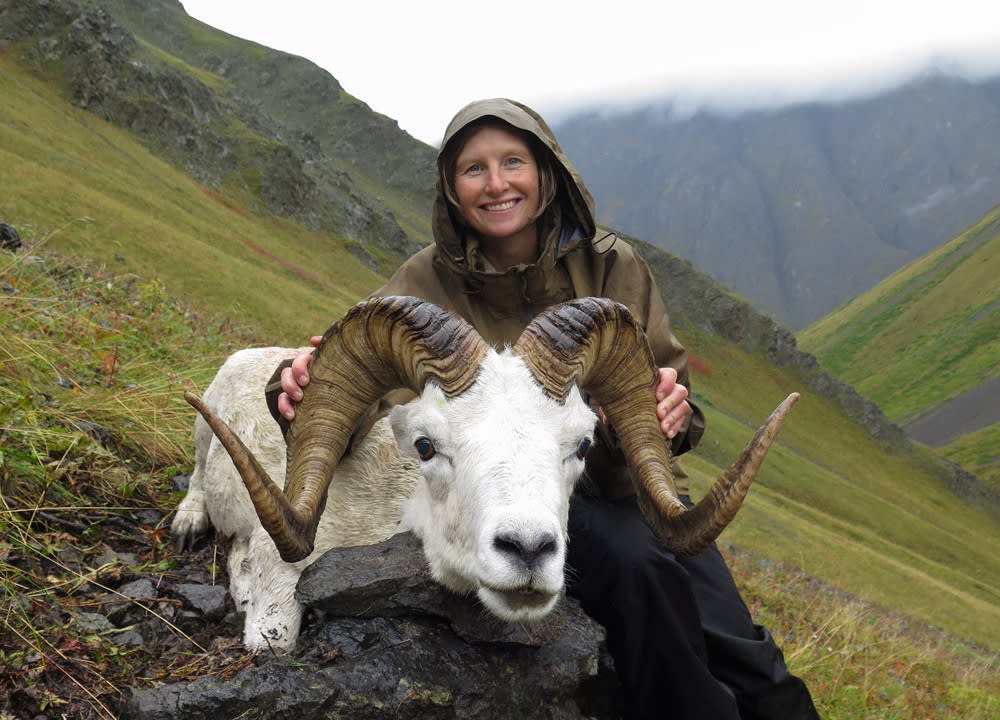
Overview
Dall sheep are somewhat smaller and slimmer than Stone sheep. It is white, with amber hoofs and horns. The horns are slimmer than in other North American sheep, more triangular in cross section and relatively longer. Horn conformation varies with the region, some ranges featuring sheep with tight curls, others with more flare; however, the typical mature Dall ram has horns that flare outward at the tips after making a full curl. Females have short, slender horns.
Taxonomy
- Kingdom
- Animalia
- Phylum
- Chordata
- Class
- Mammal
- Order
- Artiodactyla
- Family
- Bovidae
- Genus
- Ovis
- Species
- Thinhorn sheep, dalli
Habitat
Alpine country, including glacier edges, below permanent snow line. Essential elements are steep, rugged cliffs and rock outcroppings for escape from predators, and nearby meadows for feeding.
Diet
When food is abundant during the summer they eat a wide range of plants, but during the winter their diet is much more limited and consists mainly of dry, frozen grass, sedge stems, lichens, and mosses.
Behavior
Females group together with lambs and yearlings, and males herd together separately, except during the rut in early winter.
Hunting
It is currently the least difficult and least expensive North American sheep to hunt. Being white, they are easy to spot (except in snow), which is a distinct advantage when hunting them as compared with other sheep. Most hunts in Alaska are conducted on foot from fly-in camps, as there are only a few horse outfits in the state. All hunts in the Yukon and northwestern British Columbia are horse hunts, often for several species. The Northwest Territories offers horse hunts, and also riverboat hunts and strenuous backpack hunts. On horse hunts, the horses are used only on the approach, with the actual stalk made on foot. SCI's rule for record keeping purposes is that a Dall sheep may have no dark hairs whatever, except on the tail. Any sheep that is not completely white (other than the tail) will be treated as a Stone sheep.
Conservation Status
Listed as Least Concern by the IUCN. About one quarter of Alaska's sheep population is now totally protected in national parks and monuments. Dall sheep populations are high and are stable throughout their range.