
Overview
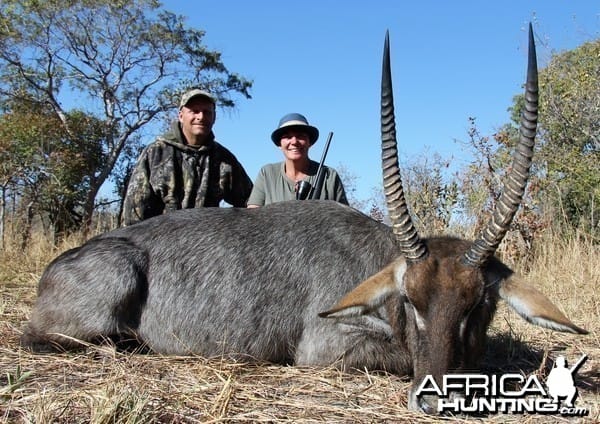
The overall color is dark gray without any reddish tinge. Very little white by the eyes. There is a solid white patch on the lower part of the rump below the tail. The horns are shorter than in either the sing-sing or East African defassas.
Taxonomy
- Kingdom
- Animalia
- Phylum
- Chordata
- Class
- Mammal
- Order
- Artiodactyla
- Family
- Bovidae
- Genus
- Kobus
- Species
- Kobus ellipsiprymnus
Habitat
Woodlands, forests, and grasslands with nearby water sources. Distribution- In Zambia, from the upper Zambezi River eastward to the Muchinga escarpment (which is a southern extension of the Great Rift Valley). Also in adjoining parts of Katanga Province in Congo (K).
Diet
Their habitat furnishes them with a year-round source of food. Mainly grazers, they consume types of coarse grass seldom eaten by other grazing animals and occasionally browse leaves from certain trees and bushes.
Behavior
Although males do compete for and hold territories, the waterbuck is generally a quiet, sedentary animal. Like some other antelopes, the male does not mark his territory with dung or urine, as his presence and smell are apparently sufficient. He tries to retain females that wander into his area, but is seldom successful for long, since the females have large home ranges and, in herds of 5 to 25, are constantly crossing in and out of males territories. Waterbucks do not migrate or move great distances, so territories are usually held year round.
Hunting
Good glass will is essential, as they can be spotted from quite some distance on the open grasslands and flood plains where they are most often found. While having excellent eyesight and hearing, the waterbuck is not the hardest African plains game to approach.
Conservation Status
Listed as Least Concern by IUCN.