
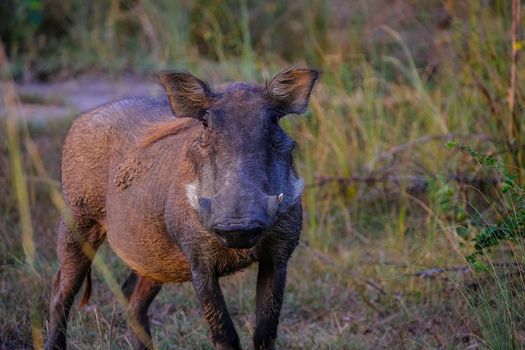
Taxonomy
- Kingdom
- Animalia
- Phylum
- Chordata
- Class
- Mammal
- Order
- Artiodactyla
- Family
- Suidae
- Genus
- Phacochoerus
Habitat
Common warthogs primarily inhabit savannas, grasslands, and woodlands in sub-Saharan Africa, often near water sources for drinking and wallowing. They prefer open areas with access to burrows for shelter and are adaptable to various terrains from arid regions to moist forests.
Diet
Common warthogs are omnivores that mainly eat grasses, roots, bulbs, and fruits, using their snout to dig for food. They also consume insects, eggs, and occasionally small vertebrates or carrion, feeding primarily during the day in small groups.
Behavior
Common warthogs are diurnal and live in groups called sounders, typically consisting of females and their young, while adult males are often solitary or lead the group during mating season. They exhibit territorial behavior by marking areas with secretions and are known for kneeling on their front knees to graze, using abandoned burrows for shelter and protection.
Hunting
Hunting the common warthog is a popular and effective conservation tool in sub-Saharan Africa, where regulated hunts fund habitat protection and anti-poaching efforts through fees that support local wildlife management programs, similar to successful models in Southern African conservancies. Employ spot-and-stalk methods in open savannas and grasslands, or set up blinds near water sources where warthogs frequent for drinking and wallowing, focusing on early morning or late afternoon when they are most active; use a rifle with calibers like .30-06 Springfield, .308 Winchester, or .300 Winchester Magnum for reliable penetration and ethical kills, aiming for the vital organs just behind the shoulder for a quick, humane harvest. The best seasons are during the dry months from May to October in countries such as South Africa, Namibia, Tanzania, and Zimbabwe, where populations are managed through quota systems to ensure sustainability. For trophy criteria, target males with prominent tusks exceeding 25 cm in length for Safari Club International (SCI) records, emphasizing well-developed warts and overall size; legal hunting is also available on private game ranches in Texas, USA, where introduced populations contribute to conservation funding and population control.
Conservation Status
The IUCN status of the common warthog is Least Concern, though populations are decreasing due to habitat loss, hunting, and human-wildlife conflict. Major threats include agricultural expansion and poaching for meat and tusks.