
Overview
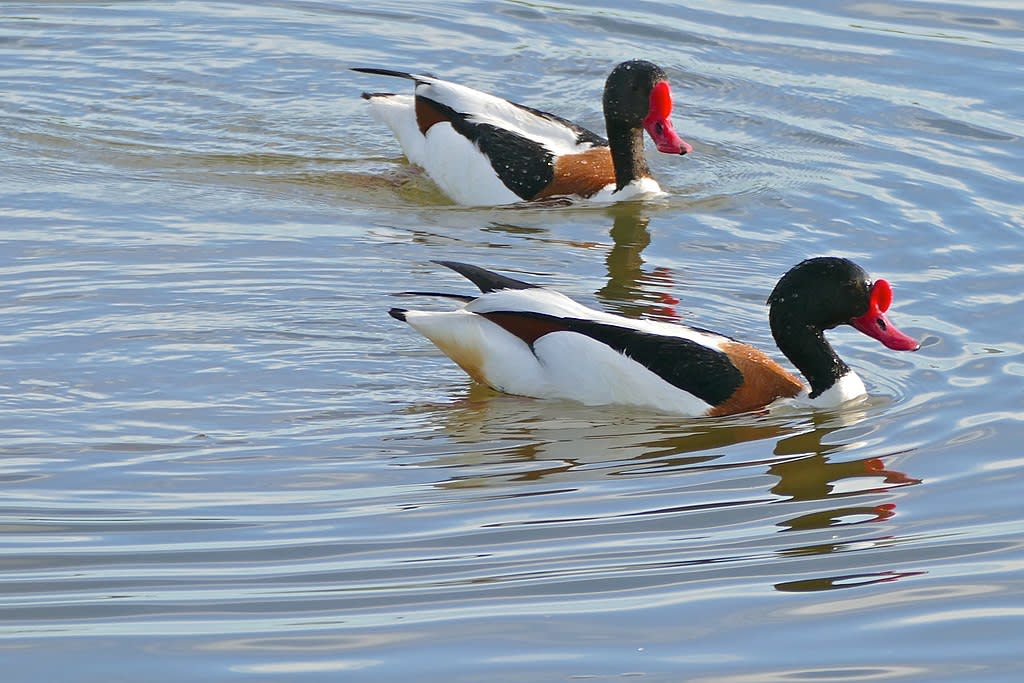
The common shelduck resembles a small short-necked goose in size and shape. It is a striking bird, with a reddish-pink bill, pink feet, a white body with chestnut patches and a black belly, and a dark green head and neck. The wing coverts are white, the primary remiges black, and the secondaries green (only showing in flight) and chestnut. The underwings are almost entirely white. Sexes are similar, but the female is smaller, with some white facial markings, while the male is particularly crisply coloured in the breeding season, his bill bright red and bearing a prominent knob at the forehead. Ducklings are white, with black cap, hindneck and wing and back patches. Juveniles are similarly coloured, greyish above and mostly white below, but already have the adult's wing pattern. The call is a loud honk.
Taxonomy
- Kingdom
- Animalia
- Phylum
- Chordata
- Class
- Bird
- Family
- Anatidae
- Genus
- Tadorna
- Species
- tadorna
Habitat
Moulting flocks can be very large (100,000 on the Wadden Sea), since most pairs leave their partially grown young in a crèche with just one or two adults. This species is mainly associated with lakes and rivers in open country, breeding in rabbit burrows, tree holes, haystacks or similar. In winter it is common on suitable estuaries and tidal mudflats as well.
Diet
It is omnivorous and feeds on grasses, the young shoots of plants, grain and water plants as well as both aquatic and terrestrial invertebrates. On land it grazes on the foliage, in the water it dabbles in the shallows, and at greater depths, it up-ends, but it does not dive.
Behavior
The young will dive under water to avoid predators and the adults will fly away from them to act as a decoy.
Hunting
Hunted across its range.
Conservation Status
Listed as Least Concern by IUCN.