
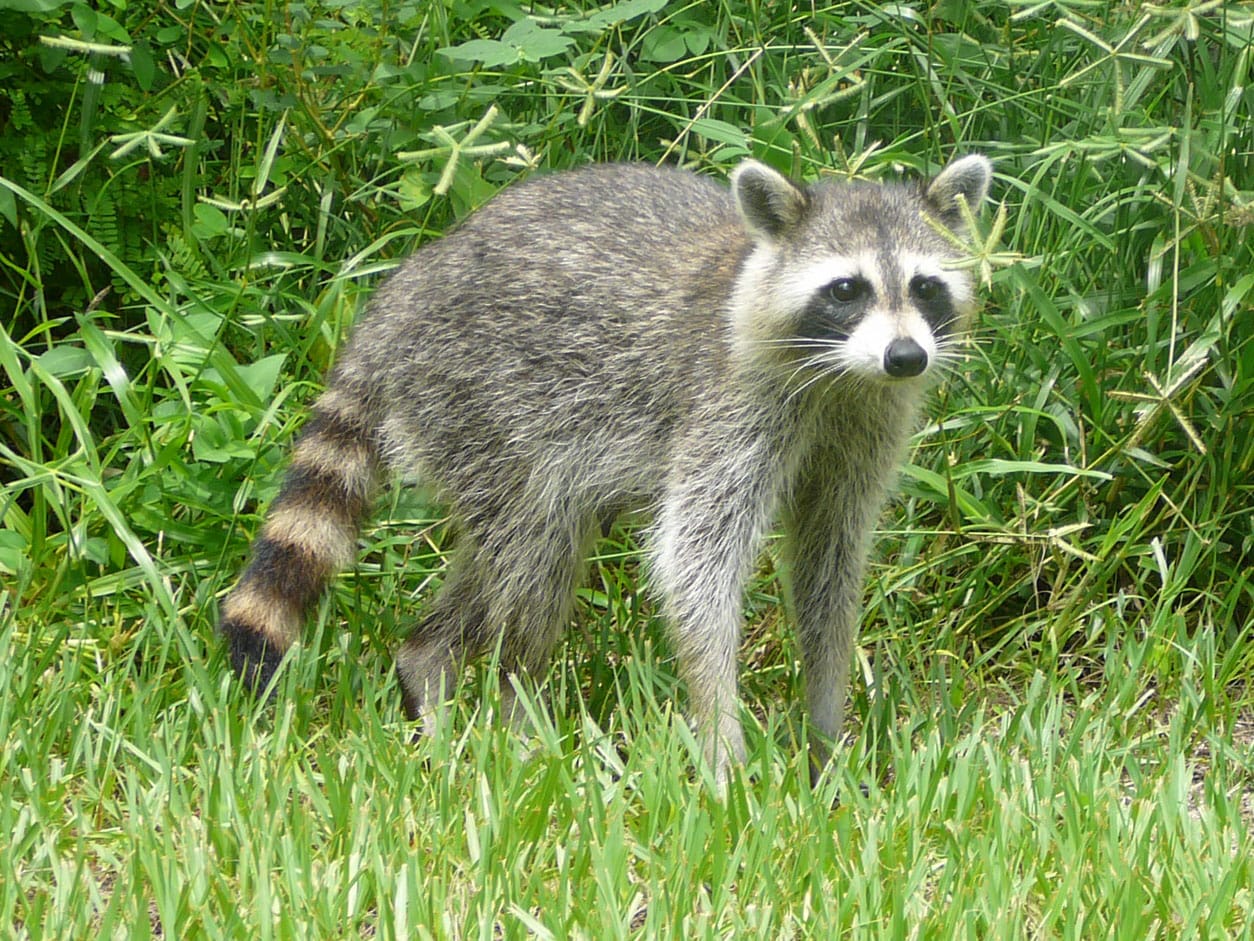
Taxonomy
- Kingdom
- Animalia
- Phylum
- Chordata
- Class
- Mammal
- Order
- Carnivora
- Family
- Procyonidae
- Genus
- Procyon
Habitat
Common raccoons inhabit a wide range of environments including forests, wetlands, urban areas, and farmlands across North and Central America. They prefer regions with access to water sources and dense cover for dens, such as hollow trees or abandoned burrows, making them highly adaptable to both rural and suburban settings.
Diet
Raccoons are omnivorous, feeding on a variety of items including fruits, nuts, insects, small mammals, fish, and human garbage. They exhibit nocturnal foraging behavior, often using their paws to probe for food in water or soil, and are opportunistic scavengers that adapt their diet based on seasonal availability.
Behavior
Raccoons are primarily nocturnal and solitary, though family groups may forage together; they are highly adaptable and often raid trash cans in urban areas. They display territorial behavior by marking dens with scent and are known for their dexterity in handling objects, such as 'washing' food in water. In the wild, they are excellent climbers and swimmers, using these skills to escape predators or find food.
Hunting
Raccoons are a popular small game species managed through regulated hunting, which helps control populations in urban and rural areas, funding conservation efforts via license fees that support state wildlife programs under the North American Model. Effective methods include night hunting with spotlights, calling, or using dogs to track them in forests and farmlands, ensuring minimal disturbance to non-target species. For equipment, use precise calibers like .22 LR rifles or 20-gauge shotguns for accurate, ethical shots at close range, prioritizing head or vital area placement. The best seasons are typically fall and winter, when raccoons are more active and pelts are prime, with specific dates varying by state in the US—such as Texas, Louisiana, Pennsylvania, and others—or provinces in Canada, where regulations promote sustainable harvests. While not a trophy species in major record books like Boone & Crockett, hunters often seek larger individuals with high-quality fur for mounting or sale, contributing to local economies and population health management that keeps raccoon numbers stable and reduces human-wildlife conflicts.
Conservation Status
The IUCN status for the common raccoon is Least Concern, with populations stable or increasing due to their adaptability to human environments; major threats include road accidents and hunting in some areas.
Subspecies (22)
- Torch Key raccoonProcyon lotor incautus
- Guadeloupe raccoonProcyon lotor minor
- Mexican Plateau raccoonProcyon lotor hernandezii
- Colorado Desert raccoonProcyon lotor pallidus
- Bahamian raccoonProcyon lotor maynardi
- California raccoonProcyon lotor psora
- Eastern raccoonProcyon lotor lotor
- Florida raccoonProcyon lotor elucus
- Baja California raccoonProcyon lotor grinnelli
- Isthmian raccoonProcyon lotor pumilus
- Key Vaca raccoonProcyon lotor auspicatus
- Matecumbe Key raccoonProcyon lotor inesperatus
- Mississippi Delta raccoonProcyon lotor megalodous
- Pacific Northwest raccoonProcyon lotor pacificus
- Saint Simon Island raccoonProcyon lotor litoreus
- Short-faced raccoonProcyon lotor simus
- Snake River raccoonProcyon lotor excelsus
- Ten Thousands Islands raccoonProcyon lotor marinus
- Texas raccoonProcyon lotor fuscipes
- Tres Marias raccoonProcyon lotor insularis
- Upper Mississippi Valley raccoonProcyon lotor hirtus
- Vacouver Island raccoonProcyon lotor vancouverensis