
Overview
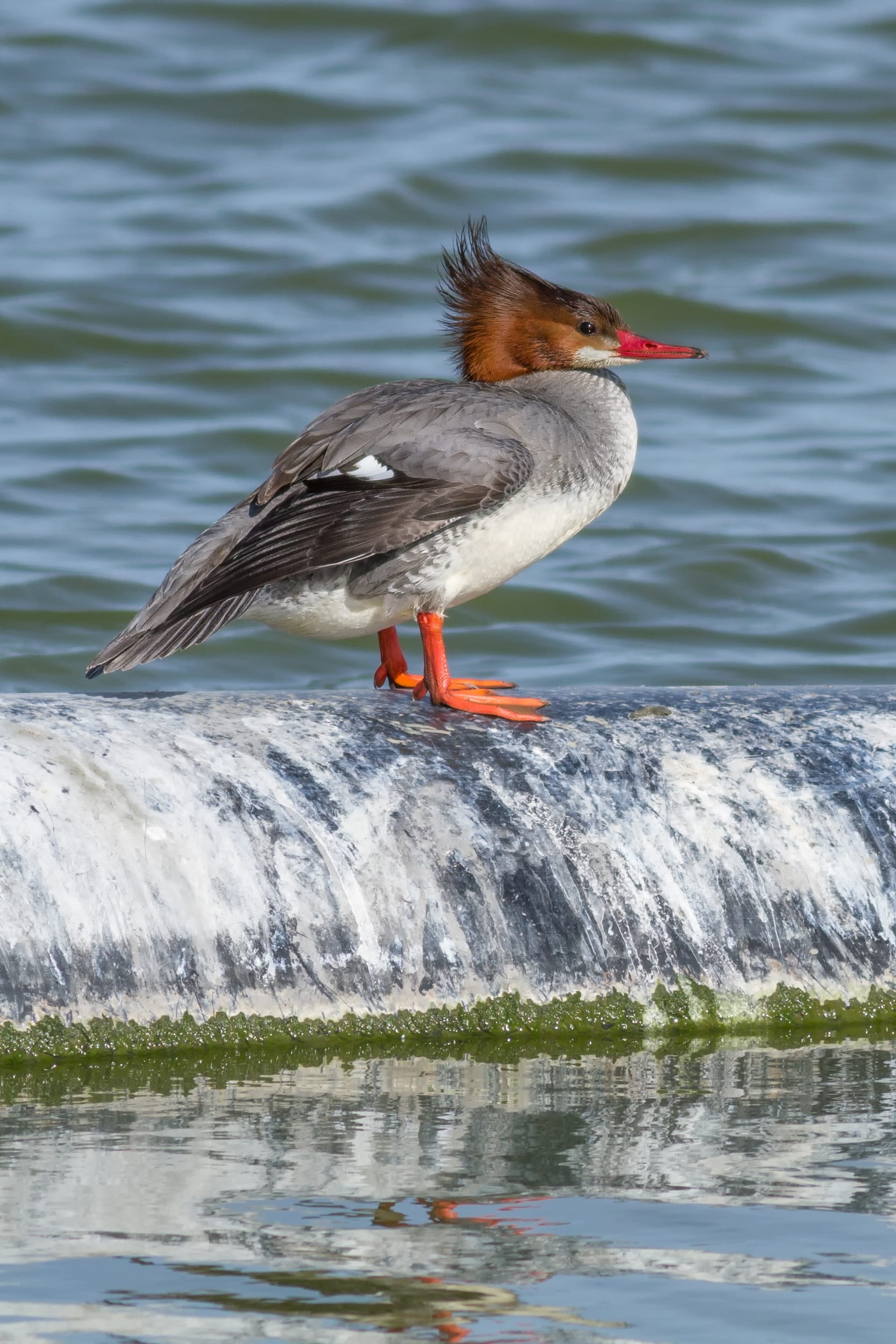
Like other species in the genus Mergus, it has a crest of longer head feathers, but these usually lie smoothly rounded behind the head, not normally forming an erect crest. Adult males in breeding plumage are easily distinguished, the body white with a variable salmon-pink tinge, the head black with an iridescent green gloss, the rump and tail grey, and the wings largely white on the inner half, black on the outer half. Females, and males in eclipse (non-breeding plumage, July to October) are largely grey, with a reddish-brown head, white chin, and white secondary feathers on the wing.
Taxonomy
- Kingdom
- Animalia
- Phylum
- Chordata
- Class
- Bird
- Family
- Anatidae
- Genus
- Mergus
- Species
- merganser
Habitat
In most places, the common merganser is as much a frequenter of salt water as fresh water. In larger streams and rivers, they float down with the stream for a few miles, and either fly back again or more commonly fish their way back, diving incessantly the whole way. In smaller streams, they are present in pairs or smaller groups, and they float down, twisting round and round in the rapids, or fishing vigorously in a deep pool near the foot of a waterfall or rapid.
Diet
Like the other mergansers, these fish-feeding ducks have serrated edges to their bills to help them grip their prey, so they are often known as sawbills. In addition to fish, they take a wide range of other aquatic prey, such as molluscs, crustaceans, worms, insect larvae, and amphibians; more rarely, small mammals and birds may be taken. As in other birds with the character, the salmon-pink tinge shown variably by males is probably diet-related, obtained from the carotenoid pigments present in some crustaceans and fish. When not diving for food, they are usually seen swimming on the water surface, or resting on rocks in midstream or hidden among riverbank vegetation, or (in winter) on the edge of floating ice.
Behavior
In most places, the common merganser is as much a frequenter of salt water as fresh water. In larger streams and rivers, they float down with the stream for a few miles, and either fly back again or more commonly fish their way back, diving incessantly the whole way. In smaller streams, they are present in pairs or smaller groups, and they float down, twisting round and round in the rapids, or fishing vigorously in a deep pool near the foot of a waterfall or rapid. When floating leisurely, they position themselves in water similar to ducks, but they also swim deep in water like cormorants, especially when swimming upstream. They often sit on a rock in the middle of the water, similar to cormorants, often half-opening their wings to the sun.
Hunting
Typically hunted with a 12 ga shotgun. Shot size #2-4 is sufficient. Effectively hunted with decoys and calling. Dogs are used for bird retrieval. Steel shot is required for waterfowl in the United States.
Conservation Status
Listed as Least Concern by IUCN.