
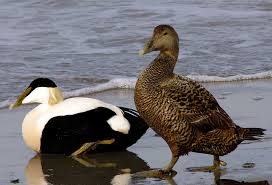
Overview
The common eider is both the largest of the four eider species and the largest duck found in Europe and in North America (except for the Muscovy duck which only reaches North America in a wild state in southernmost Texas and south Florida). It is characterized by its bulky shape and large, wedge-shaped bill. The male is unmistakable, with its black and white plumage and green nape. The female is a brown bird, but can still be readily distinguished from all ducks, except other eider species, on the basis of size and head shape.
Taxonomy
- Kingdom
- Animalia
- Phylum
- Chordata
- Class
- Bird
- Family
- Anatidae
- Genus
- Somateria
- Species
- mollissima
Habitat
They nest on coastal islands in colonies ranging in size of less than 100 to upwards of 10,000-15,000 individuals.
Diet
This species dives for crustaceans and molluscs, with mussels being a favoured food.
Behavior
Eiders are colonial breeders. They nest on coastal islands in colonies ranging in size of less than 100 to upwards of 10,000-15,000 individuals. Female eiders frequently exhibit a high degree of natal philopatry, where they return to breed on the same island where they were hatched. This can lead to a high degree of relatedness between individuals nesting on the same island, as well as the development of kin-based female social structures.
Hunting
Typically hunted with a 12 ga shotgun. Shot size #2-4 is sufficient. Effectively hunted with decoys and calling. Dogs are used for bird retrieval. Steel shot is required for waterfowl in the United States.
Conservation Status
Listed as Least Concern by IUCN.