
Overview
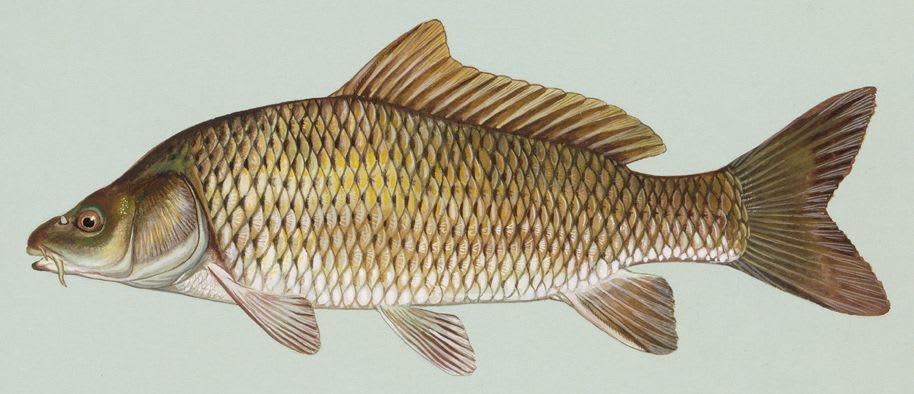
The carps closest look alikes may be the bigmouth and smallmouth buffalos (Ictiobus cyprinellus and I. bubalus), which despite their resemblance to the carp, belong to an entirely different family, Catostomidae (the “sucker” family). The carp, the goldfish, and the buffalos all grow fairly large (the goldfish to about 16 inches; the carp and buffalos much larger); all have deep bodies; relatively small, protractile mouths; a forked tail; a single, long dorsal fin on the back; and large scales. The coloration of their bodies is also similar, ranging from olive brown to gold. Still, all these species can be quite easily distinguished. The carp and the goldfish both have a single serrated spine at the beginning of the dorsal and anal fins. All the fins are soft on the buffalos, with no spines at all, only soft rays. The carp has two fleshy barbels on each side of the mouth, distinguishing it from the goldfish, which lacks barbels. In Europe, where the carp is highly regarded, farmed, and selectively bred, cultivated carp (referred to as “king” carp as opposed to wild carp) come in a variety of body shapes and squamation patterns. They may be fully scaled, partially scaled (“mirror” carp), or completely nude (“leather” carp). They are still the same species and after a few generations in the wild, will revert to their normal wild form.
Taxonomy
- Kingdom
- Animalia
- Phylum
- Chordata
- Class
- Actinopterygii
- Order
- Labriformes
- Family
- Cyprinidae
- Genus
- Cyprinus
- Species
- carpio
Habitat
The carp's original range was limited to temperate Asia and the rivers of the Black Sea and Aegean basins, notably the Danube, in Europe. Today, they are widely distributed in North America below the 50th parallel south to the Florida panhandle. Besides North America, Europe, and Asia, it is also now found in South America, Africa, Australia and New Zealand. It is very prolific, an excellent survivor and is able to tolerate a wide range of conditions and bottom types, therefore making it an excellent species for pond culture.
Diet
Small Fish, Eggs, Leaves, Roots, Seeds, Grains, Insects, Zooplankton, Crustaceans, Mollusks
Behavior
Carp are omnivores. They eat animals and plants living in the mud at the bottom of rivers and lakes. Newly hatched carp feed on algae and microscopic animals that drift in the water called zooplankton. As they get older and larger they feed on larger invertebrates like Tricoptera, Gastropoda, and Malacostraca. Usually, carp spawn in shallows and flooded areas in water depths of less than 0.5 m, but spawning has been observed in 1.8 m deep water. Carp exploit large and small man made and natural reservoirs, and pools in slow or fast moving streams. They prefer larger, slower-moving bodies of water with soft sediments but they are tolerant and hardy fish that thrive in a wide variety of aquatic habitats.
Fishing
Common carp are extremely popular with anglers in many parts of Europe, and their popularity as quarry is slowly increasing among anglers in the United States (though destroyed as pests in many areas), and southern Canada. Carp are also popular with spear, bow, and fly fishermen.
Conservation Status
Listed as Vulnerable by IUCN.